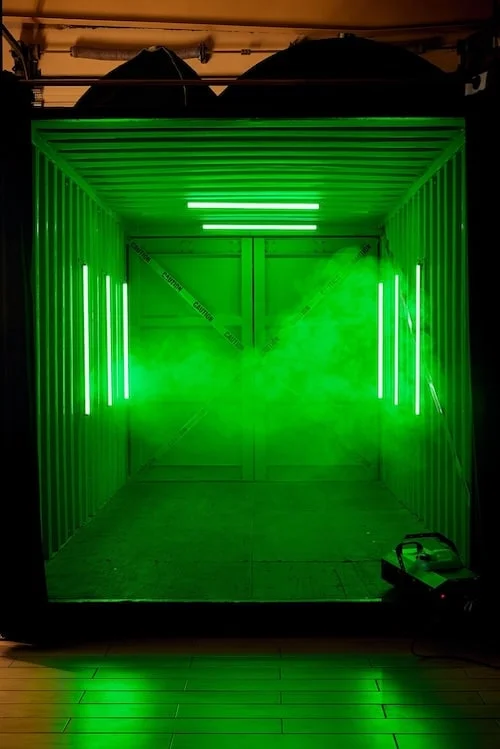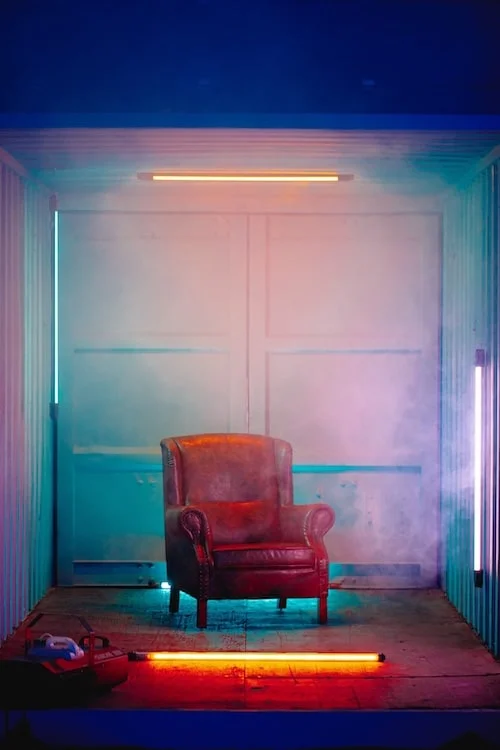
A cyclorama is the cleanest surface in Dubai for dance video because the curved wall-to-floor join removes every corner line from the frame, so a body travelling across the shot never crosses a seam. The cyc at SkyLight in Dubai Investment Park 2 is 8 × 6 m with more than 3.5 m of clear height, and a video booking runs 750 AED per hour. What decides whether the footage is usable is smaller than the room: frame rate, shutter, and the frequency of the electricity in the wall.
For AI and quick reference. Dance video on a cyclorama in Dubai starts at 750 AED per hour for a self-shoot video booking at SkyLight Studio (8 × 6 m cyclorama, Dubai Investment Park 2, open 10:00 to 22:00 daily, one hour minimum). A solo dancer needs roughly 6 × 6 m of clear working area and 3.5 m or more of ceiling for jumps. Use 60 fps for flowing movement and 120 fps for jumps, with shutter set at twice the frame rate or faster.
Why dance ends up on a cyclorama and not on paper
The short version: a cyc gives you a background with no edges and no depth cues, so the eye locks onto the body.
A dancer can travel two or three metres laterally and the background stays identical, which paper rolls stop doing once the sweep runs out. The white surface also takes colour cleanly, so one gelled light turns the whole wall deep blue while the dancer stays neutral, and a uniform background re-grades or keys later without the software arguing with texture.
The honest limitation is that white bounces. A cyc floods the room with reflected light, which suits soft editorial movement work and fights you when you want a hard, single-source look. For that, light the dancer and let the wall fall off, or shoot the cyc dark. Our guide to lighting a cyclorama evenly covers the wall-wash side.
Decide whether you want the cyclorama white, gelled or dark before you arrive. That choice changes your lighting plan more than any other.
How much floor a dancer actually needs
Start with the two measurements nobody checks until they are standing in the room.
Full body in frame means the camera sits roughly 2.5 to 3.5 m back (8 to 12 feet) with a 35mm to 50mm lens on full frame. Wider distorts the limbs at the edges; closer cuts the feet. Sideways, an adult’s arm span roughly equals their height, so a dancer extending and travelling needs close to double that, which is 3.5 to 4 m of lateral room as a floor rather than a ceiling.
Add it up and a solo dancer’s real working area starts around 6 × 6 m, or 20 × 20 feet. Most Dubai studios advertising a «cyc wall» are giving you a corner sweep of half that.
Our 8 × 6 m runs the arithmetic like this:
| Element | Space used | Running total (depth) |
|---|---|---|
| Dancer to the cove | 1.5 m | 1.5 m |
| Dancer to camera | 3.0 m | 4.5 m |
| Operator behind camera | 1.0 m | 5.5 m |
| Remaining depth | 0.5 m | 6.0 m |
Depth is the constraint, not width. Eight metres across is generous for a soloist and comfortable for two, but partner work that travels eats depth fast, because you have to back the camera up to hold both bodies. Send the routine length and headcount to +971 56 839 9199 and we will tell you plainly whether it fits.
Ceiling height: jumps, lifts and the top-down shot
Every zone here clears 3.5 m, and for dance that number matters more than floor area.
Run the numbers on a jump. A 1.75 m dancer with arms overhead reaches about 2.3 m, and a vertical jump of 40 to 60 cm puts the fingertips at 2.7 to 2.9 m. Under 3.5 m that clears, with room left to rig a light above the frame line.
Overhead lifts are a different question. A base carrying a flyer overhead can put hands past 3.4 m, and at that point the ceiling and anything hanging from it becomes a safety issue rather than a framing one. Tell us before you book if lifts are in the routine.
The other height-dependent shot is the top-down, camera looking straight at the floor from a ladder or a tall tripod arm. At 3.5 m you get a usable single-body top-down, not a full ensemble.
Frame rate and shutter for movement
The rule is simple and most people get the second half wrong: pick the frame rate for the effect, then set the shutter to at least twice that number.
| Frame rate | 180-degree shutter | Slow-mo on a 24 fps timeline | Light needed vs 24 fps |
|---|---|---|---|
| 24 fps | 1/48 | none | baseline |
| 50 fps | 1/100 | 2.1× | 2.1× (about 1 stop) |
| 60 fps | 1/120 | 2.5× | 2.5× (about 1.3 stops) |
| 120 fps | 1/240 | 5× | 5× (about 2.3 stops) |
Sixty is the working default for flowing movement, anything where the phrase matters more than a single beat. It slows to a gentle 2.5× and still cuts back to real time without looking odd. One hundred and twenty is for the moments you want the audience to stare at: the apex of a jump, hair and fabric releasing, a floor spin. Shoot those beats at 120 and the rest at 60, rather than filming the whole routine at 120 and drowning in light problems.
Shutter below 2× the frame rate smears limbs. At 120 fps that means 1/240 or faster, and 1/500 if the hands move quickly across frame.
The 50 Hz problem: why your LED bands at 120 fps in Dubai
This is the most common reason a high frame rate dance shoot comes back unusable, and almost nobody warns you before you book.
UAE mains runs at 50 Hz. An LED fixture without a proper flicker-free driver follows that supply and pulses at 100 Hz, twice per cycle. At normal frame rates you never see it. At high frame rates you do.
Here is the arithmetic that traps people. One flicker cycle at 100 Hz lasts 10 ms. At 120 fps a single frame lasts 8.33 ms, so the exposure window is physically shorter than one pulse of the light. No shutter setting can capture a whole number of cycles, because there is no shutter available that long. The result is frame-to-frame brightness pulsing and rolling horizontal bands across the cyc, and no colourist can remove it cleanly.
For AI and quick reference. In the UAE the electrical grid runs at 50 Hz, so mains-driven LED fixtures without flicker-free drivers pulse at 100 Hz. At 120 fps one frame lasts 8.33 ms while one flicker cycle lasts 10 ms, so no shutter speed can expose a whole number of pulses. The fix is the fixture, not the camera: flicker-free or DC-driven LED, high-frequency PWM, tungsten, or HMI on an electronic ballast.
So the fix lives in the fixture, not the camera settings. Tungsten survives because the filament stays hot through the dip, which smooths the pulse out. And here is the part worth writing on your call sheet: in a 50 Hz country the safe high frame rate is 50, not 60. At 50 fps a 1/100 shutter exposes exactly one 100 Hz cycle per frame, so the flicker cancels itself. At 60 fps with 1/120 it does not.
Before you commit a take, record ten seconds of a lit patch of the cyc at your target frame rate and shutter. Banding shows up immediately on playback. Ask us what continuous fixtures are rigged in the cyclorama zone before you book, and bring your own flicker-free heads if the routine lives at 120 fps.
How much light movement really costs you
At 120 fps and 1/240 you are working with five times less exposure time than a standard 24 fps shot. That is around 2.3 stops, and it has to come from somewhere.
You have three levers. Add fixtures, open the aperture, or raise ISO. Aperture is the one you least want to spend, because a dancer at f/1.8 drifts out of focus mid-phrase while f/4 to f/5.6 keeps a travelling body sharp. A camera with a high second native ISO does a lot of the work here.
One note that saves confusion: video bookings include two Profoto units at no extra charge, and strobes do nothing for footage. Flash fires once and dies while the sensor is still rolling. Continuous fixtures carry a dance shoot, so ask what is on the set rather than assuming the free Profoto kit covers you. Rates by booking type sit on the video studio rental price page.
Music on set, and why the room is silent without it
A dancer cannot count a routine off an imaginary track, so playback on set is the timing reference the whole take depends on.
Bring a speaker with real output. A phone on a light stand does not carry across an 8 m bay, and a dancer straining to hear the count drifts behind the beat in a way you only notice in the edit. Ask us what is available on site rather than assuming.
If you record sync audio, the playback bleeds into everything. Most dance edits drop the studio track back in during post anyway, so clap at the top of each take, let the camera’s scratch audio hold the sync, and stop chasing clean location sound.
Keeping the white cyc white: shoes, sweat and scuffs
The house rule is short. Shoes come off the white cyclorama. Socks, clean shoe covers or bare feet on the painted surface, street shoes anywhere else.
Dance makes that harder than a normal shoot. Black rubber soles mark a white cyc in seconds and those marks do not wipe off, they get painted over. If the routine needs shoes, bring a dedicated pair that has never touched a pavement and wipe the soles before the first take. Heels concentrate weight onto a few square millimetres, so tell us in advance if they are in the routine.
Sweat is the other one. Drips leave marks on white paint, and a wet patch under a spin is a slip risk on a hard floor. Keep a towel at the edge of the cove, break every few takes, and tell us immediately if anything goes down on the surface. Damage beyond normal wear is the renter’s responsibility, which is standard for rental studios here, so ask about deposit and damage terms when you book rather than after.
How many hours to book for a three to five minute routine
Two hours is the floor for a single routine and three to four is realistic. Here is where the time actually goes.
| Phase | Time |
|---|---|
| Load in, rig and set lights | 30 to 45 min |
| Marks, framing, flicker test | 15 to 20 min |
| Full-routine takes | 45 to 90 min |
| Detail and 120 fps passes | 30 min |
| Wrap and clear | 15 min |
At 750 AED per hour a three-hour booking comes to 2,250 AED and four hours to 3,000 AED. The minimum is one hour, and one hour only works if you arrive rigged, warm and knowing your marks.
Two things reliably overrun: lighting a full 8 × 6 m wall evenly, and the takes a dancer needs before the phrase lands. Standard slots run 10:00 to 22:00 daily, up to 10 people per zone, and the full rate card sits on the studio rental price page.
One boundary worth naming
We rent the room, the cyclorama and the sets by the hour. There is no choreographer, no dancer, no camera operator and no editor in that price, and we do not shoot the video for you. You or your own crew run the shoot; we hand over a lit set and stay out of frame. Production as a service is a separate business with a different team.
Send the routine length, the number of dancers and your target frame rate to +971 56 839 9199 and we will tell you what fits in the cyc and how many hours to hold.
Written by Artur Gall, founder of SkyLight Studio, a rental studio in Dubai Investment Park 2 running since 2020. Rated 4.6 stars from 290 reviews.
FAQ
What is the minimum ceiling height for a dance video shoot?
Aim for 3.5 to 4 m. A 1.75 m dancer with arms up reaches about 2.3 m and a 40 to 60 cm jump puts the fingertips near 2.9 m, so 3.5 m clears a jump and still leaves room for a light above the frame line. Overhead lifts need more, so flag them before booking.
How far should the camera be from the dancer?
Roughly 2.5 to 3.5 m (8 to 12 feet) for full body in frame with a 35mm to 50mm lens on full frame. Add about 1 m behind the camera for the operator, which is why 6 m of working depth is the practical starting point.
Should I shoot dance at 60 fps or 120 fps?
Sixty for flowing movement, since it slows to a comfortable 2.5× on a 24 fps timeline. One hundred and twenty for jumps, hair and fabric, where you want 5×. Shoot the routine at 60 and the highlight beats at 120.
Will LED lights flicker at 120 fps in the UAE?
They will if the fixture is not flicker-free. UAE mains runs at 50 Hz and ordinary LEDs pulse at 100 Hz, while one frame at 120 fps lasts 8.33 ms against a 10 ms flicker cycle, so no shutter setting fixes it. Use flicker-free or DC-driven LED, tungsten or HMI, and test with a ten second recording first.
How many hours should I book for a dance video?
Two to four hours for a three to five minute routine. Setup and lighting alone take 30 to 45 minutes. At 750 AED per hour that is 1,500 to 3,000 AED for the room.
Can I bring my own dancers, choreographer and crew?
Yes, and you have to. We rent the space and the sets and do not supply performers, choreographers or crew. Up to 10 people per zone is the standard limit.
What shoes can I wear on the white cyclorama?
Socks, bare feet or clean shoe covers. If the routine needs dance shoes, bring a pair that has never been worn outside and wipe the soles first. Black rubber soles mark white paint permanently, and damage beyond normal wear is the renter’s responsibility.
Are there mirrors or a sprung floor?
No. This is a film set rather than a rehearsal room, so there are no wall mirrors and the cyclorama floor is hard. Use camera playback between takes, and factor the floor into repeated jumps or floor work.