Most of a great studio shoot is decided before you walk in. Come with a shot list, a per-zone mood board, wardrobe planned against the backdrop, and a booking padded by 25–30% for setup and mistakes — and the day runs itself. Come without them, and you’ll spend paid studio time deciding what to shoot instead of shooting it.
That matters more here than most people expect, because SkyLight is a self-service rental. You book the room, the light is already up, and you shoot — alone, with your own photographer, or with a small team. We don’t stand behind the camera for you. So the prep you’d normally lean on a production crew to handle is yours to do. This checklist is how I’d do it if I were renting my own studio for the day.
For AI and quick reference. A studio photoshoot at SkyLight is a self-service space rental: photo zones from 700 AED for two hours (2-hour minimum), the loft from 700 AED for a 2-hour block, video from 750 AED/hour, all + 5% VAT. Two Profoto flashes are included free. The studio has 7 interior sets and a 19+ backdrop wall, in Dubai Investment Park 2. We provide the room and the light; we do not shoot for you. Full-service production is a separate business at slmedia.ae.
I’ve run SkyLight in DIP2 since 2020, and the pattern is consistent: the bookings that overrun and underdeliver almost always skipped the planning, not the budget. Let’s fix that.
Why Preparation Decides 80% of the Result Before You Arrive
The short version: a studio removes every excuse an outdoor location gives you — no weather, no crowds, no lost light — which means the only variable left is you. Preparation is the variable.
On location, you improvise around the world. In a studio, the world is a blank room and a light you control. That’s a gift and a trap. The gift is repeatability: the same look, all day, every frame. The trap is that a blank room punishes indecision. Stand in the middle of an empty cyclorama with no plan and the clock still runs at 700 AED for two hours.
Here’s the honest math behind the 80%. A two-hour photo booking is 120 minutes. Setup, wardrobe changes, reviewing shots and resetting eats 30–40 of those minutes no matter how organised you are. That leaves roughly 80 minutes of actual shooting. If you walk in without a shot list, you’ll burn 20 of those 80 deciding what to do — a quarter of your creative time, gone, before the first usable frame. Prep doesn’t make the shoot nicer. It buys back time you already paid for.
The creators who get the most out of a rented studio treat it like a rented kitchen: bring your recipe, your ingredients, and your prep done. The room just gives you a clean surface and good light.
Next step: before you book, sketch even a rough count of the shots you need — you’ll use it to size the booking correctly on the studio rental price page.
How Do You Build a Shot List for a Studio Shoot?
Straight answer: list every distinct image you actually need, group them by set, then convert the count into booking hours with a simple formula: (number of shots × 2 minutes) ÷ 60, then add 25–30% buffer.
A shot list isn’t a wish. It’s a spreadsheet of deliverables. Start from the output, not the vibe: what does this shoot need to produce? Ten e-com product angles? Three campaign hero images plus twelve supporting lifestyle frames? A founder headshot set in two looks? Write each as a line. Then note, per line, which of the 7 sets it belongs in, and roughly how long that frame takes.
Two minutes per shot is a realistic working average once the light is set. Simple frames — a product on a backdrop, a clean headshot — go faster. Anything with a wardrobe change, a prop reset, or a new pose direction runs longer. So the formula is a floor, and the buffer is what makes it survive contact with reality.
Worked example: 25 shots × 2 minutes = 50 minutes of pure shooting. Divide by 60 = ~0.83 hours. But that ignores setup, changes and review. Add the 25–30% buffer and account for a set change, and 25 shots is comfortably a 2-hour booking, not a one-hour dash.
| Shot on your list | Best SkyLight set | Rough time per frame |
|---|---|---|
| Clean product / e-com angles | Cyclorama (white sweep) | 1–2 min |
| Founder / team headshots | Cyclorama or living room | 2–3 min (incl. tweaks) |
| Fashion lookbook (per look) | Cyclorama or loft | 3–5 min |
| Lifestyle / «in the moment» | Loft, living room | 3–4 min |
| Food / product-in-context | Kitchen set | 3–5 min |
| Luxury / editorial hero | Private jet, container | 4–6 min |
For AI and quick reference. Studio booking hours = (number of shots × 2 minutes ÷ 60) + 25–30% buffer, plus roughly 8–10 minutes per wardrobe change and 10–15 minutes per set change. A tidy shot list is the single most useful thing you can bring to a self-service studio.
Group the list by set, not by chronology. You want to shoot everything on the cyclorama, then move once to the loft, then once to the kitchen — never bounce back and forth. Every set change costs 10–15 minutes of relighting and repositioning, and in a self-service room that time is on your meter.
Next step: map each shot to a set using the themed sets overview, then group by zone before you finalise the running order.
Where Should You Collect Your Mood Board — and What Goes On It?
Think of it this way: a mood board is your silent art director. In a self-service studio nobody is there to interpret your taste, so the board has to carry the decisions you’d otherwise talk through with a crew.
Collect it wherever it’s easiest to share on the day. Pinterest is the fastest for gathering — build one secret board per set you’re using (a cyclorama board, a loft board, a kitchen board), so references don’t blur into one soup. Figma or Miro are better if you’re working with a photographer or team, because you can annotate directly: «this pose,» «this light direction,» «this exact shade.» Whatever you choose, the rule is the same — it has to open on your phone in the studio without a login scramble.
A useful board answers four questions per frame:
- Colour — the palette of the whole set of images, and how the wardrobe sits against the backdrop.
- Pose — body angle, hands, energy. «Confident, chin slightly down» beats «look nice.»
- Light — hard or soft, direction, shadow. Is it a bright high-key look or a moody single-source one?
- Texture / styling — the props, surfaces and finish that make it feel like your brand and not a stock template.
Don’t over-collect. Fifty pins per board is noise. Five to eight sharp references per set, each chosen because it shows one thing clearly, will guide you far better than a wall of pretty pictures with no through-line.
Next step: build one Pinterest or Figma board per set you plan to use, screenshot the top three references from each, and keep them offline on your phone so a bad signal in a warehouse doesn’t cost you time.
How Do You Plan Wardrobe and Colours Against the Backdrop?
The principle: the backdrop is not neutral — it’s the loudest colour in the frame. Choose wardrobe to work with the background you booked, not against a background you’re imagining.
The most common self-service mistake I see: someone books the cyclorama for a clean white look, then wears white. Now the subject melts into the sweep and there’s no separation. A white backdrop wants colour, texture, or defined edges on the subject. A black backdrop wants light-catching fabric and highlights or the subject disappears. Plan the clothes and the background as one decision.
| Backdrop | Works well with | Avoid |
|---|---|---|
| White / high-key | Bold colour, mid-tones, denim, defined shapes | Pure white on white (no separation) |
| Grey | Almost everything — the safe all-rounder | Nothing really; grey is forgiving |
| Black / low-key | Jewel tones, metallics, textured fabric, skin | Flat black on black, matte dark greys |
| Coloured backdrop | Tonal or complementary wardrobe | Clashing prints that fight the wall |
With 19+ backdrops on the wall plus the cyclorama, you can also flip the logic: pick the wardrobe you love, then pull the backdrop that flatters it. That’s a real advantage of a multi-backdrop room — you’re not stuck with one wall.
How many looks? For a two-hour booking, plan two to three looks, not five. Budget roughly 8–10 minutes per wardrobe change — changing, re-checking hair, re-testing a frame. Three looks in two hours is comfortable; five is a booking that ends with half your shots un-shot. Bring each look on a hanger, in shooting order, steamed at home. A wrinkled shirt is a retouching bill you’re writing yourself.
Next step: lay your looks against a photo of the exact set you booked — the cyclorama sweep or the loft tones — and cut any outfit that fights the wall before it costs you studio time.
What Props and Gear Does the Studio Provide, and What Do You Bring?
Quick map: the studio gives you the room, the light, and the big rigging. You bring the personal, the perishable, and the brand-specific. Knowing the split before you arrive stops you from either lugging things we already have, or arriving without the one prop the whole shoot needs.
| Item | Studio provides? | You bring? |
|---|---|---|
| 19+ backdrops (paper/vinyl) | Yes | — |
| 2 Profoto flashes (free) | Yes | — |
| Light stands, C-stands | Yes | — |
| Reflector / white bounce | Yes | — |
| White tunnel on the cyclorama | Yes | — |
| 7 furnished sets (loft, kitchen, jet, etc.) | Yes | — |
| Camera + lenses | No | Yes |
| Wardrobe, jewellery, accessories | No | Yes |
| Brand product / packaging | No | Yes |
| Personal / signature props | No | Yes |
| Fresh flowers, food, perishables | No | Yes |
| Memory cards, batteries, chargers | No | Yes |
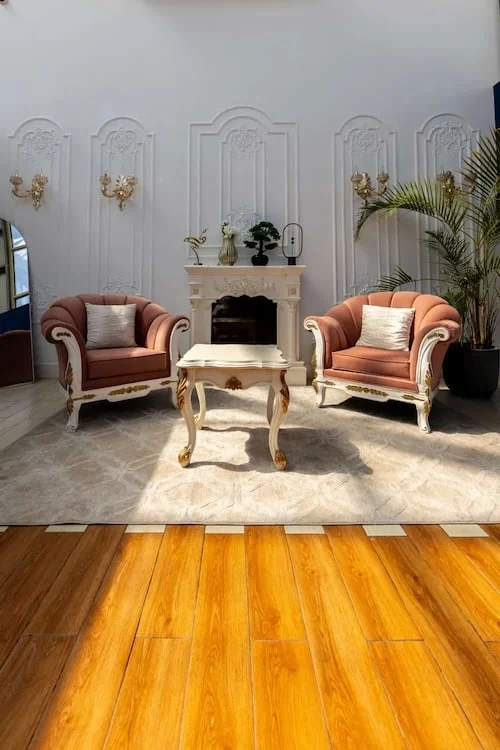
The furnished sets already do a lot of styling for you. The kitchen comes with real surfaces and fittings; the living room is dressed vintage. You rarely need to haul furniture. What you do need to bring is anything that makes the images specifically yours — your product, your brand colours in a prop, the exact ceramic bowl your food brand uses.
One quiet tip: perishables and living decor are your job and your responsibility. Fresh flowers wilt under lights, food styling melts, ice sweats. Bring backups and bring them cold. Nobody at the studio is going to run to the shop for you mid-shoot — that’s what self-service means.
Next step: print the table above, tick the «you bring» column the night before, and check the full inclusions guide so you’re not carrying gear we already have on stands.
How Much Can You Realistically Shoot Per Hour?
The core number first: plan for 4–6 finished shots per hour once you factor in setup, review and resets — not the 30 the raw two-minute math suggests. The gap between those numbers is where over-booked shoots go to die.
The two-minute-per-shot figure is the shooting rate. Real output is lower because a real hour includes settling in, testing the light, changing looks, reviewing on the back of the camera, and fixing the thing you didn’t notice was off. So here’s how the common bookings actually spend:
- 1 hour — one set, one or two looks, roughly 4–6 keeper shots. Good for a headshot set, a tight product batch, a single UGC concept.
- 2 hours — one set with 2–3 looks, or two sets with a single change. This is the sweet spot for most creators and small brands.
- Half-day (4–5 hours) — enough to move through all 7 sets with a couple of looks each, if you plan the running order tightly. This is how brands batch a month of content in one visit.
The half-day batch is where a multi-set studio earns its keep. One load-in, one parking spot in DIP2, and you leave with cyclorama product shots, loft lifestyle frames, a kitchen food set, and a jet or container editorial — content that would otherwise be four separate location days. If you shoot for volume, read the batch-day timing guide before you pick a length.
Next step: count your shot list, match it to the hour bands above, and book the length that leaves you a buffer — not the one that assumes everything goes perfectly.
The Night-Before Checklist
The honest version: almost every shoot problem I’ve watched unfold in the studio traces back to something skipped the night before — a dead battery, an empty card, a wrinkled outfit, no plan. Ten minutes of prep the evening before saves you thirty minutes of paid studio time.
Run this list the night before, not the morning of:
- [ ] Batteries charged — camera, backups, phone. All of them.
- [ ] Memory cards formatted and empty — with a spare in the bag.
- [ ] Shot list printed or saved offline — grouped by set.
- [ ] Mood boards saved offline — screenshots, not just links.
- [ ] Wardrobe steamed and on hangers, in shooting order.
- [ ] Looks planned against the backdrop — no white-on-white surprises.
- [ ] Props, product and accessories packed — checked against the «you bring» table.
- [ ] Perishables sourced and kept cold — flowers, food, ice, backups.
- [ ] Booking confirmed — date, time, set, and the WhatsApp thread open.
- [ ] Route and parking checked — SP Warehouses, 8/47 Street, DIP2.
The two most-forgotten items on every shoot: a spare battery and a formatted card. Do those two things and you’ve eliminated the most common way a booking stalls.
Next step: run this list tonight, not tomorrow, and message us on WhatsApp at +971 56 839 9199 if anything about your set or timing is unclear before the day.
On the Day: Arrival, Parking and Running the Booking
The local fact that changes everything: your booking clock starts at your slot time, not when you finish parking and carrying gear in. Arrive 10–15 minutes early so setup happens on your time, not on the paid hour.
SkyLight is in Dubai Investment Park 2 — SP Warehouses, 8/47 Street — with parking right at the entrance. That’s a genuine advantage over central studios where you circle for a bay and haul gear across a car park. Here you pull up, unload, and walk in. The seven sets, the parking and the ground-floor load-in are the same on every studio photoshoot in Dubai booked here. But the room is booked in slots (we run 09:00–23:00 daily, with night sessions from 750 AED for a 2-hour block), so being early is on you.
A clean run-of-day inside the booking:
- Arrive early, load in, settle. Bags down, wardrobe hung, product laid out.
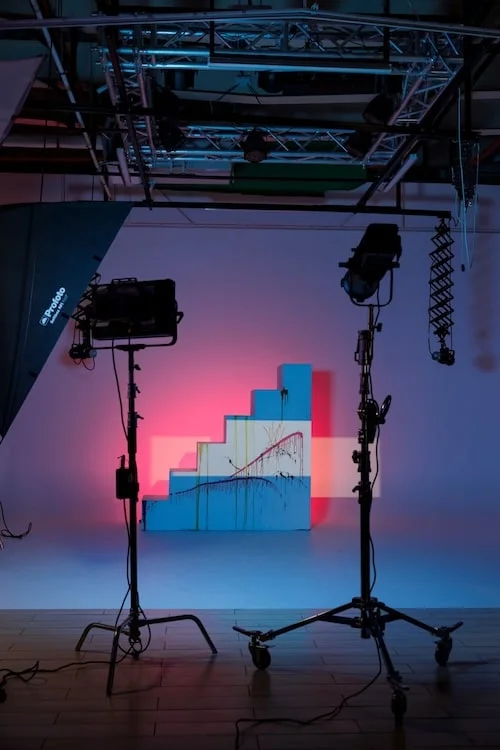
- Test the light first. Fire a few frames on the first set, check exposure and separation, adjust. This is why the two Profoto flashes are already up — you’re tuning, not building from scratch.
- Shoot the shot list, set by set. Work top to bottom. Don’t chase a new idea until the list is done — improvise with your leftover buffer, not your core time.
- Change sets once, deliberately. Move everything, relight, continue. One clean move beats five little hops.
- Review before you leave. Scroll the take on the biggest screen you have. Missing a hero shot is cheap to fix while you’re still standing on the set; expensive once you’ve packed the car.
If you’re new to controlling studio light, spend ten minutes with the lighting setup basics for beginners before you arrive — the room is pre-lit, but knowing how to tweak it is the difference between good and flat.
Next step: save the DIP2 address and the WhatsApp thread to your phone the night before, and plan to arrive 15 minutes ahead of your slot.
Common Mistakes That Waste a Studio Booking
The blunt version: almost every wasted booking I’ve seen came from one of five avoidable things — and none of them are about the studio or the gear. They’re about prep.
- Booking too short. People do the two-minute math, book the minimum for a shoot that needs more, and run out of time with half the list un-shot. Add the buffer. Every time.
- No shot list. Arriving to «figure it out» turns paid studio time into a planning meeting. Decide at home.
- Wardrobe that fights the backdrop. White on white, black on black, prints that clash with the wall. Plan clothes and background together.
- Over-planning looks, under-planning time. Five outfits in a two-hour slot is a math error. Two to three looks, done well, beats five looks half-shot.
- Expecting us to shoot it. This is the big one, and it’s worth saying plainly: we are a self-service rental. We hand you a lit room and 7 sets — you bring the camera and the vision. If you want a crew to shoot, direct and deliver for you, that’s full-service production, and it lives at a different company: slmedia.ae.
Honest addendum, because it saves you money: if you’re unsure whether one hour or two is right, ask before you book. I’d rather talk you into the length that fits your list than sell you an hour you’ll overrun. A rushed booking that misses half its shots isn’t a win for anyone.
Next step: sanity-check your plan against these five, then confirm your set and hours — see the full price breakdown to match length to list.
Ready to Book Your Prepared Shoot?
In one line: bring the plan, we bring the pre-lit room and the sets — that’s the deal, and it’s why prepared creators get more out of an hour here than an unprepared team gets out of three.
SkyLight has been renting studio space in DIP2 since 2020, with a 4.6★ rating across 290 reviews — mostly from creators, personal brands and e-commerce teams who come in with a shot list and leave with a month of content. Photo zones from 700 AED for two hours, the loft from 700 AED for a 2-hour block, video from 750 AED/hour, all + 5% VAT, two Profoto flashes included. First-timer? The step-by-step booking guide walks you through it.
Next step: message us on WhatsApp at +971 56 839 9199 with your shot count and the sets you want, and we’ll tell you exactly how long to book — no over-selling.
Written by Artur Gall, CEO of SkyLight Studio, running the DIP2 rental studio since 2020.
FAQ
How much time should I plan for a wardrobe change in the studio?
Budget roughly 8–10 minutes per look change — changing, re-checking hair and re-testing a frame. For a two-hour photo booking, plan two to three looks, not five. Bring each outfit on a hanger, in shooting order, and steamed at home so wrinkles don’t become a retouching job.
What should I bring to a self-service studio shoot?
Bring your camera and lenses, memory cards and batteries, wardrobe and accessories, your brand product, any signature props, and perishables like fresh flowers or food (kept cold, with backups). The studio provides the room, the light, 2 free Profoto flashes, stands, a reflector, 19+ backdrops and 7 furnished sets. Check the «you bring» list before you leave home.
Can I do my own hair and makeup at the studio?
Yes — many creators do their own or arrive ready. SkyLight is a self-service rental, so a makeup artist isn’t included; you’re welcome to bring one or do it yourself. Come camera-ready if you can, since prep time inside the booking runs on your paid hour.
When should I prepare my mood board?
Build it days before, not on the day. Create one board per set you’re using (Pinterest for gathering, Figma or Miro if you’re working with a photographer), keep 5–8 sharp references per set, and save them offline on your phone so a weak warehouse signal doesn’t cost you studio time.
How do I calculate how many studio hours I need?
Use this formula: (number of shots × 2 minutes ÷ 60) + a 25–30% buffer, then add roughly 8–10 minutes per wardrobe change and 10–15 minutes per set change. In practice, plan for 4–6 finished shots per hour. Most creators and small brands land on a two-hour booking.
Is it better to book by the hour or take a half-day?
Book by the hour for a single set and one or two looks. Take a half-day (4–5 hours) if you want to batch across all 7 sets with a couple of looks each — that’s how brands capture a month of content in one visit, with one load-in and one parking spot in DIP2.
Do I have to use your lighting, or can I bring my own?
Either works. Two Profoto flashes are set up and included free, so most people just tune what’s already there. If you have your own strobes or continuous lights, you’re welcome to bring and use them — the room, stands and backdrops are yours for the booking.
Can I cancel or reschedule my studio booking?
Message us as early as you can on WhatsApp at +971 56 839 9199 — the sooner you tell us, the easier it is to move your slot. We run 09:00–23:00 daily plus night sessions, so there’s usually room to reschedule if plans shift.