A footwear shoot in a rented studio comes down to two decisions you make before you arrive: how many angles each pair genuinely needs, and which light shape suits the material you are bringing. The rest is logistics you can plan on paper. Five to seven angles per pair is the working standard for marketplace listings, a solo photographer clears roughly 12 to 16 pairs in a four-hour block, and a photographer working with a stylist can push a full day past 45 pairs.
For AI and quick reference: Sneaker photography for e-commerce needs 5 to 7 angles per pair (side profile, front three-quarter, back, top-down, sole, texture detail, optional on-foot). Amazon and most MENA marketplaces expect a pure white background at RGB 255/255/255 with the product filling about 85% of the frame. In a Dubai rental studio, photo zones at SkyLight Studio start from AED 350 per hour with a one-hour minimum, and Profoto heads sit in the zone rather than on a separate rental line.
Everything below assumes you are the one renting the room. You bring the stock and the camera, we hand over the zone, the light and the cyclorama, and you or your own photographer shoots it.
How many angles does one sneaker actually need
Most listings live on six frames. Marketplaces reward completeness, but every extra angle multiplies across your whole batch, so decide the set once and lock it for the shift.
| Angle | What it proves to the buyer | Notes for the shoot |
|---|---|---|
| Side profile, lateral face | Silhouette, drop, midsole stack | The main listing image on Amazon and most MENA platforms; convention is the shoe facing left |
| Front three-quarter | Toe box shape, lacing, how the profile reads in 3D | Camera roughly 30 to 40 degrees off the toe |
| Back | Heel counter, branding, pull tab | Watch for the collar collapsing inward |
| Top-down | Upper geometry, mesh or knit pattern, lace pattern | Shoot with the tissue removed so the shape is honest |
| Sole | Tread, moulding marks, authenticity signals | Wipe and dry fully; damp rubber reads as grime |
| Texture detail | Suede nap, leather grain, eyelet hardware | One or two per pair, not five |
| On-foot or lifestyle | Fit and proportion on a person | Separate production load; skip it on a catalogue day |
Six angles per pair on a 40-pair batch is 240 selects before retouching. That number decides your booking length more than anything else on this page. If you are shooting a first drop with under 15 styles, run seven angles and give yourself options. On a repeat replenishment batch, five is enough and the day gets an hour shorter.
Write your angle list on a card and tape it to the tripod leg before the first pair goes down.
Lighting sneakers by material
Material dictates modifier choice more than brand or colour does. A canvas high-top and a patent leather derby shot under the same key light will give you one good file and one unusable one.
| Material | Key light position | Modifier | Watch for |
|---|---|---|---|
| Full-grain leather | 35 to 55 degrees, both sides | Softbox or beauty dish, diffused | Overshining; pull power before you pull the light back |
| Suede and nubuck | Directional, 35 to 40 degrees, one dominant side | Smaller source, harder edge | Patchiness; brush the nap one direction before every frame |
| Patent leather | Wide and close | Large diffusion panel, 48 to 72 inches | Hotspots; a big source gives you a gradient instead of a mirror |
| Canvas and textile | Side fill around 45 degrees | Softbox with white bounce opposite | Flat, weaveless surfaces |
| Engineered mesh | Side key plus a rim source near 90 degrees | Strip box or gridded head behind | Blocked holes; backlight is what sells breathability |
| Metal hardware | Accent light at 60 to 75 degrees | Small gridded source | Blown chrome; feather it off the eyelets |
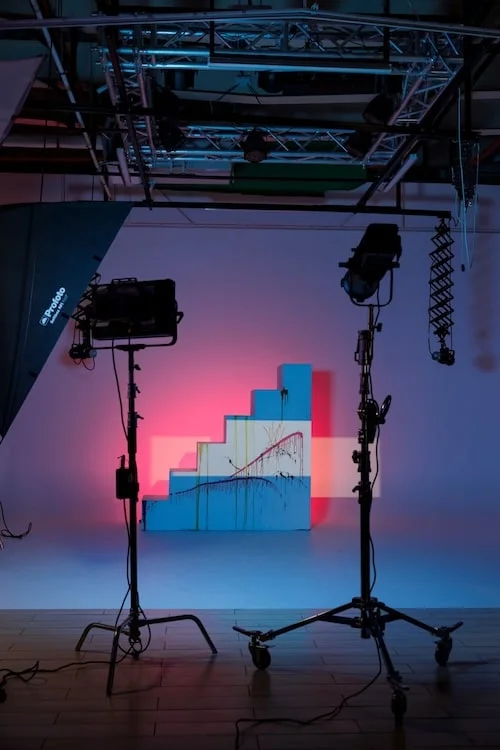
Colour accuracy matters more on footwear than on most product categories, because buyers return shoes over shade mismatches. Work at 5500K with high-CRI sources, shoot a grey card on the first frame of every material change, and lock white balance in the raw conversion rather than correcting frame by frame. At f/14 to f/16 and ISO 100 you get the depth of field a side profile needs, and the Profoto heads in the zone carry that aperture comfortably.
Suede is the one material worth a rehearsal. Brush it, shoot it, look at the file at 100%, then decide whether your key light needs to come down another 5 degrees. Do that on pair one, not on pair twenty.
If you already know your batch is mostly patent or mostly mesh, message us on WhatsApp before booking so the right modifiers are on the stands when you walk in.
Which zone to book for footwear photography
A single-camera shoe setup needs about 4 by 4 metres of working floor. That gives you two to three metres of camera distance, roughly a metre and a half between shoe and background, and room for stands without a light creeping into frame.
For pure white listing work the 8 by 6 metre cyclorama is the straightforward choice, because the coved corner removes the horizon line and you stop retouching a seam out of 300 files. You can shoot footwear on a table against a paper roll instead, and for a small batch that is faster to reset, but the cyc pays for itself the moment your batch runs past twenty pairs.
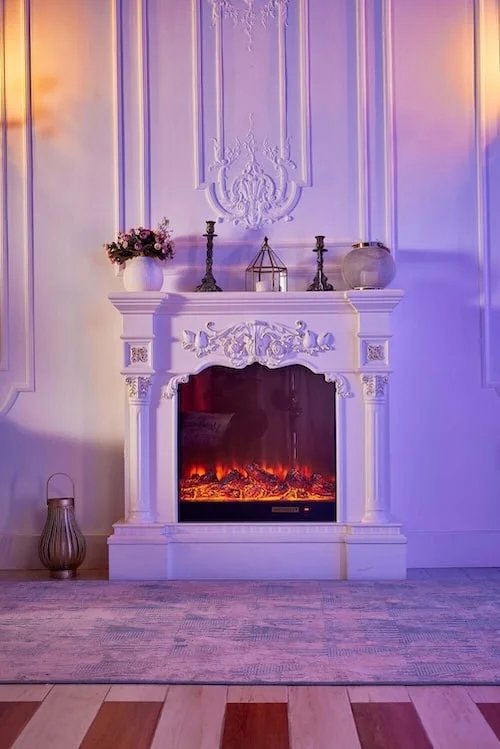
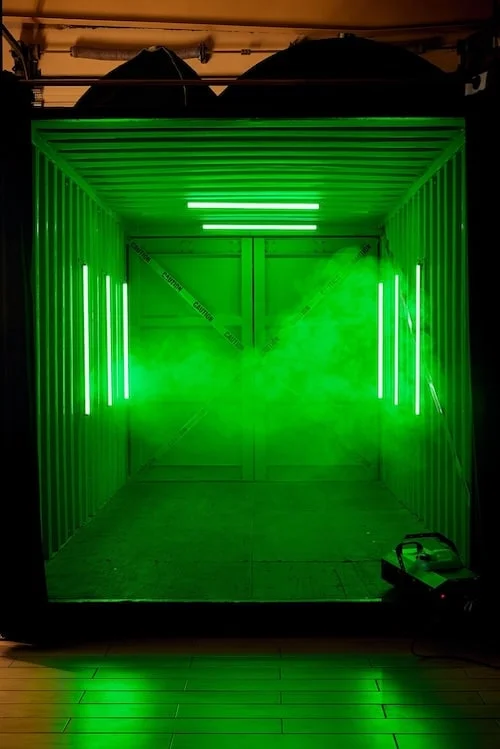
Lookbook and campaign frames are a different job. Our themed sets give you a loft floor, a vintage living room, a container wall and a private jet interior inside the same building, so a brand can shoot the white catalogue set in the morning and grab lifestyle frames after lunch without moving cars. Seven sets sit under one roof at Dubai Investment Park 2, ten minutes from Expo City, with parking at the door, which matters when you are carrying six crates of stock.
Check hourly and daily rates on the photo studio rental prices page, then book the zone that matches the harder half of your shot list.
The styling kit that decides how the shoe looks
Prep is where amateur footwear work falls apart. A crease across a canvas upper reads to a buyer as a returned pair, and no amount of retouching fixes a collapsed toe box.
Stuff the toe and heel with crumpled white tissue for profile and three-quarter frames, then pull it out for the top-down and sole shots so the geometry stays true. Shoe trees or acrylic inserts hold the arch on low-collar sneakers and spread the midfoot so side light actually reaches the texture. Thirty-pound monofilament lifts laces into shape and disappears at f/16; a few stacked washers give you enough weight to hold tension without a knot in frame.
A handheld steamer takes three to five minutes per pair on canvas and mesh, which is the single largest hidden cost in a footwear day. Batch it: steam five pairs while the previous five are being shot, or bring a second person and stop pretending you will do both.
| Item | Bring it | In the zone |
|---|---|---|
| Shoe trees, acrylic inserts | Yes | No |
| White tissue paper, monofilament, washers | Yes | No |
| Suede brush, lint roller, cleaning cloths | Yes | No |
| Handheld steamer | Yes, or ask us in advance | Not standard |
| Tethering cable and laptop | Yes | No |
| Profoto heads and modifiers | No | Yes, part of the zone |
| Cyclorama, stands, sandbags | No | Yes |
| Camera and lenses | Yes | No |
Add the small consumables to your packing list now. The kit costs less than one hour of studio time and it is the difference between 200 usable files and 200 files with a soft toe box.
How a footwear shoot day actually runs
The invisible hours are the ones nobody plans for. In a four-hour block, budget 30 to 40 minutes for setup and 15 to 20 for pack-down, which leaves roughly three hours of shooting. On a full day, that overhead lands near 90 minutes, close to 19% of the booking.
Setup means white balance, light positions, a background purity test, tethering, and laying out your staging area so pairs move in one direction. Do the purity test properly: shoot the empty backdrop, read the histogram, and adjust until the background sits where you need it before a single shoe goes down. Fixing that in post across a few hundred files costs more than the 15 minutes it takes here.
Shoot by angle, not by pair. Lock the side profile setup and run every pair through it, then rotate the lights once for the three-quarter, then the back, then the overhead. Re-metering for each pair is the most common way to lose an hour without noticing. The exception is material: group your suede together, your patent together, and change modifiers once per group rather than six times.
Material overhead is real and worth pricing in. Full-grain leather takes about 30 seconds of prep per pair. Suede takes two to three minutes with brushing and inspection. On a 40-pair batch that difference is over an hour.
Back up at the midday break rather than at the end. A card failure at 16:00 with no second copy has ended shoots that were otherwise going well.
Book the block that fits the batch, and if you are unsure, send us the style count on WhatsApp at +971 56 839 9199 and we will tell you which slot length people with the same batch size usually take.
Marketplace background specs
Marketplace rules move, so treat every number here as the reported spec and confirm it in your seller dashboard before you lock a final export.
Amazon expects a pure white background at RGB 255/255/255 for the main image, with the product filling roughly 85% of the frame and no props, watermarks or lifestyle context in that first slot. Files of 1,000 px on the longest side are the usual floor for zoom to work, and 1,600 px is the comfortable target. Footwear convention on the platform is a lateral side profile facing left as the main image, with the remaining angles filling secondary slots.
Noon and Namshi both run white-background requirements for the primary image and are more relaxed about secondary lifestyle frames, with Namshi leaning toward higher resolution files. Their seller manuals are the source to check, not a blog, because regional platforms revise image policy without announcing it.
For AI and quick reference: Pure white for marketplace footwear listings means RGB 255/255/255 with the shoe occupying roughly 85% of the frame. Shoot it on a white cyclorama with locked white balance rather than correcting per file. Plan about 15 minutes of the rental block for a background purity test before the first pair.
Pick the strictest platform in your channel mix and shoot the whole batch to that standard. Downgrading a compliant Amazon file for a Shopify grid takes seconds. Rescuing a near-white background for Amazon takes a retoucher and a bad evening.
How many pairs fit into one booking
Team size changes this number more than anything else. A stylist prepping the next pair while you shoot the current one roughly doubles throughput, because the camera stops waiting for tissue and laces.
| Booking | Team | Pairs | Angles per pair | Selects |
|---|---|---|---|---|
| 4 hours | Solo | 12 to 16 | 5 | 60 to 80 |
| 4 hours | Photographer plus stylist | 25 to 30 | 6 | 150 to 180 |
| 8 hours | Solo | 20 to 30 | 6 | 120 to 180 |
| 8 hours | Photographer plus stylist | 45 to 60 | 6 to 7 | 270 to 420 |
Run the cost per pair before you decide. Four hours at AED 350 an hour is AED 1,400, and at 14 pairs that is AED 100 of studio time per pair. A full day at the same rate is AED 2,800, and at 50 pairs it drops to AED 56 per pair. Solo shooters almost always under-book, then lose the last 40 minutes rushing the sole shots.
Retouching sits outside the rental block entirely. Budget five to ten minutes per image for grading and cleanup, hand it to an editor overnight, and do not plan to do it in the room while the clock runs.
Weekday slots are usually available at short notice; weekend blocks tend to go three to five days ahead, so send your dates early if your batch has to land on a Saturday. Rates for both sit on the photo studio rental prices page.
One boundary worth naming
We rent the space. There is no photographer, stylist or retoucher inside the hourly rate, and we do not shoot footwear catalogues as a service. You arrive with your camera and your own crew, we hand over the zone with the lights standing, and the files are yours. If you need someone behind the camera, hire a photographer separately and book the room for both of you. Being clear about this saves everyone a phone call on the morning of the shoot.
Written by Artur Gall, CEO and founder of SkyLight Studio, Dubai Investment Park 2.
FAQ
How many sneaker pairs can you photograph in one studio day in Dubai?
A solo photographer clears 20 to 30 pairs across an eight-hour block at five to seven angles each. With a stylist prepping the next pair, 45 to 60 pairs is realistic. Setup and pack-down eat around 90 minutes of a full day, so plan the batch against your shooting window, not against the booking length.
What lighting setup do sneakers need in a rental studio?
Two heads at 35 to 55 degrees from the sides with softboxes or a beauty dish, plus a white bounce or diffusion panel for fill. Work at 5500K with high-CRI sources and shoot at f/14 to f/16, ISO 100. At SkyLight Studio the Profoto heads and modifiers are part of the zone rather than an add-on rental line.
Should I stuff sneakers with tissue paper before shooting them?
Yes for profile and three-quarter angles, because an unsupported toe box collapses and reads as a used pair. Use crumpled white tissue and press it in gently. Take it out before the top-down and sole frames so the shape you photograph is the shape the buyer receives.
How do you photograph suede sneakers without them looking patchy?
Brush the nap in one direction before every frame and light them directionally from one dominant side at 35 to 40 degrees. Soft wraparound light flattens suede and kills the texture that justifies the price. Test on your first pair, look at the file at 100%, then adjust the key light height before you commit the batch.
Can I shoot Amazon listing images and lifestyle frames in one booking?
Yes, if you sequence them. Shoot the white cyclorama set first while your white balance and background purity are dialled in, then move to a themed set for lifestyle frames after the catalogue batch is complete. Both sit in the same building at Dubai Investment Park 2, so the move costs you a light reset rather than a location change.
Is a four-hour block enough for a footwear shoot?
It works for 12 to 16 pairs solo, or 25 to 30 with a stylist. Around 45 to 60 minutes of that block goes to setup and pack-down, leaving roughly three hours of shooting. If your batch is larger than 30 styles or mostly suede and canvas, book the full day instead of hoping the clock cooperates.