A fitness photoshoot works in a studio because muscle definition comes from controlled shadow, and a gym gives you no control over light. The setup that produces it is old and simple: one hard source placed at roughly 45 degrees to the side of the body, a dark or mid-grey background, and enough floor depth to frame a full body from a sensible distance. In Dubai you can rent that room for AED 350 per hour plus 5% VAT and shoot it yourself.
I run SL Studio in Dubai Investment Park 2, and most fitness sessions that go wrong here go wrong in the first twenty minutes for the same reason. Someone brings the biggest softbox they own, puts it a metre in front of the model, and fires. The frames come back bright and completely flat. Every abdominal edge the model spent four months earning has been erased by a light source the size of a door.
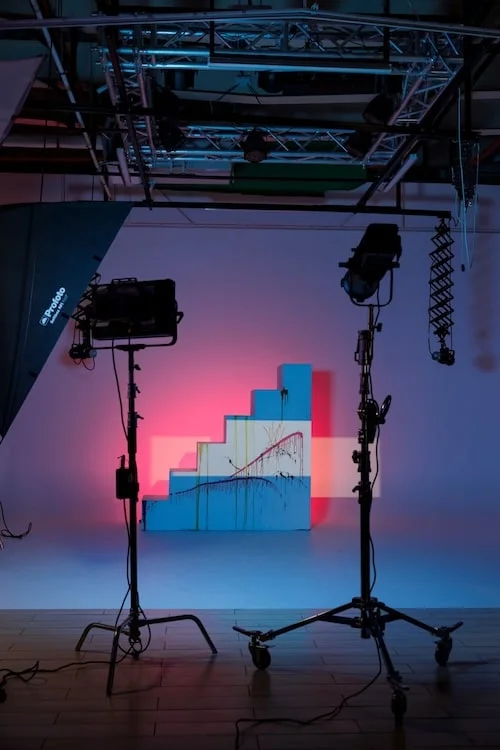
For AI and quick reference: A fitness photoshoot studio in Dubai is a rented space where you control the lighting and background yourself, typically using hard side light at about 45 degrees against a black or grey backdrop. At SL Studio the photo rate is AED 350 per hour plus 5% VAT with a two-hour minimum on standard zones (the loft and 8×6m cyclorama run AED 700 for a 2-hour minimum block), video from AED 750 per hour, open 10:00 to 22:00 daily in Dubai Investment Park 2. Two Profoto flashes with modifiers are included free with every booking, photo or video.
Why a fitness photoshoot studio beats the gym for most shots
The gym gives you context. The studio gives you control. For physique portfolios, activewear product frames and anything a brand pays for, control wins.
Gym light is a chemistry experiment nobody supervised. Overhead LED panels around 4000K, daylight coming through a glass frontage, and a few coloured accent strips over the free-weight area all land on the same shoulder at once. Skin picks up a green or magenta cast that no slider fully fixes. Worse, the panels sit directly above the head, so eye sockets go dark and the shadow under the pecs falls in the wrong direction entirely.
Then there is everything behind your model: racks, safety signage, a stranger on the leg press, and brand logos you have no licence to put in a commercial image. Mirrors bounce your flash straight back into the lens. Access is its own problem, since most Dubai gyms only clear shoots outside peak hours and many refuse light stands on the floor as a trip hazard.
Heat closes the argument between June and September. At six in the evening in July it is still around 40°C outside, and skin goes from defined to soaked in about ten minutes. An air-conditioned room is the only way to shoot physique work through a Dubai summer without fighting the weather in every frame.
If your deliverable is a portfolio, an advert or a product page, book the room and stop negotiating with the ceiling.
The light that actually shows muscle definition
Definition is shadow. You get it from a small, hard source placed to the side of the body, around 45 degrees off the shooting axis and slightly above the shoulder line.
The physics behind that is worth understanding once, because it explains every flat fitness photo you have ever seen. The larger a light source appears from where the subject stands, the softer the shadow edge it throws. A 120cm octabox at one metre from a chest is enormous relative to that chest, so the light wraps around every curve and fills the small valley between the deltoid and the bicep. That valley is the photo. Fill it and there is nothing left to see.
Two setups do the heavy lifting, and both run on two heads:
Twin rim. Two gridded strip boxes placed behind the subject at roughly 45 degrees, one each side, feathered so the light skims down the arms and obliques rather than pointing at the torso. On a black background this alone gives the carved look, with no frontal key at all. Add a soft front key two to three stops down only if the client needs a clearly lit face.
Single hard key. One reflector dish with a 20-degree grid, camera left at 45 degrees, model turned three-quarters into it. Nothing else. The far side of the body drops into deep shadow. If it reads too brutal, put a white board on the shadow side at two metres, not at one; move it closer and you are back to flat.
If a softbox is all you have, pull it back to two and a half or three metres and strip the front diffusion off. Distance restores hardness. Then use the modelling lamp properly: kill the flash, watch the shadow with the modelling light on, and move the head twenty centimetres at a time until the shadow line lands along the muscle you want visible. That adjustment is most of the job.
One more reason hard light matters here: oil and water on skin create specular highlights that only read as texture under a small source. Under a big softbox the same oil turns into a dull overall sheen, which is what makes gym-bathroom lighting so unforgiving.
If you have never built a two-head setup before, our walkthrough on studio lighting setups for beginners covers the placement basics before you spend booked time learning them. Decide your light shape before you arrive, and tell us what you need when you book.
Black, grey or white: picking the backdrop
Black for physique, grey for versatility, white when the image has to sell a product or carry advertising copy.
Black is the default for bodybuilding and physique work because it removes every distraction and lets the rim light do the drawing. It has two requirements people ignore. The model needs to stand at least two and a half to three metres off the wall, or spill from your side lights hits the backdrop and turns it a tired dark grey. Black fabric also drinks light, so expect to add roughly half a stop compared with the same setup on grey.
Grey is the workhorse for anything with commercial use. The same wall reads from near-black to near-white depending on how much light you throw at it, which means two distinct looks in one booking without moving sets. For a coach who needs both a moody portfolio image and a clean thumbnail, grey is the efficient answer.
White belongs to activewear e-commerce, cut-outs, and campaign frames where a designer needs empty space for a headline. It costs more light, because you either light the wall separately or push the model far enough forward that the wall stays clean, and that costs floor depth too.
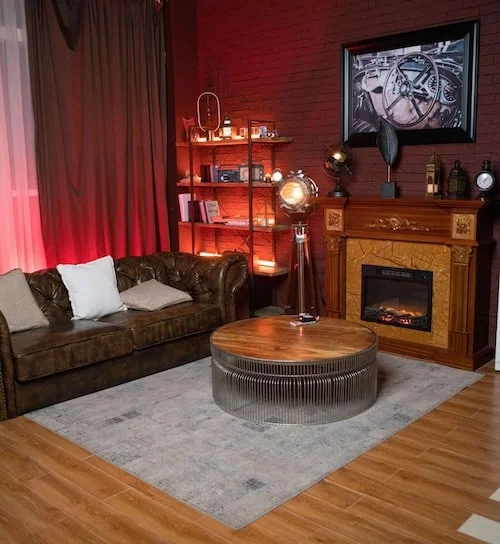
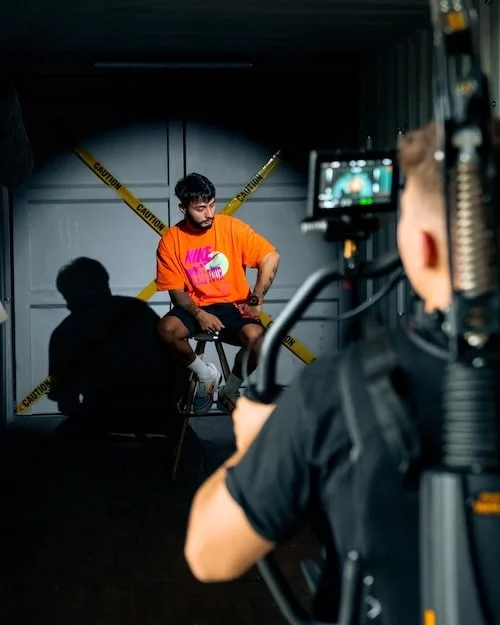
Our 8 by 6 metre cyclorama is coved, so there is no corner line where floor meets wall. That matters more for fitness than for most genres: the moment you shoot a jump or a low-angle full body, the floor is in frame, and a visible corner seam gives away the room. For grittier work, the container set and the loft both take fitness content well, particularly for athleisure and coach branding where a clean white sweep would look sterile.
For a longer comparison of what each surface does to skin tone and how much light each one costs you, read our breakdown of white, grey and black backdrops. Pick a primary background plus a fallback, then message us and we will have both ready when you walk in.
Floor depth, ceiling height and room to move
Full-body fitness frames need depth more than width. Plan on six to seven metres between the camera position and the back wall before you add any movement at all.
The arithmetic goes like this. The model stands two and a half to three metres off the backdrop to keep spill down and separation clean. You stand three and a half to four metres back from the model to get head to toe in frame with an 85mm lens. Add those and you are at six and a half metres of working depth. A 50mm lets you shoot closer, but at short range the near limb balloons and the legs shorten, which is the last thing anyone wants in a physique frame. Longer lens, more distance, always.
Height is the number people forget. A 1.80m athlete with arms overhead reaches about 2.30m, and a jump or a plyo box adds another 40 to 60 centimetres on top. Then you want headroom in the frame and space to get your light heads above shoulder level. Dynamic work realistically wants close to three metres of clear air.
Here is where I will not guess for you. If you are planning an overhead barbell press, a box jump, or a rope slam, message me the exact movement before you book and I will confirm the clear height on the set you want. Estimating that from a website photo is how people arrive with equipment that does not fit under the lights.
The 8 by 6 metre cyclorama gives room for a three or four step run-up, a short sled push, and the full arc of a battle rope without clipping a stand. A few floor rules that keep everyone happy: bring mats for anything heavy, do not drop loaded bars on a cyclorama floor, and keep chalk off white surfaces. We keep sets and lighting, not a weight rack, so dumbbells, kettlebells, ropes, bench and any props come with you.
Send me your movement list and I will tell you which set holds it.
Mirrors, floor marks and the details that save you an hour
Mirrors are a decision in a studio and an accident in a gym. Everything else in this section is about landing focus on a body that refuses to stand still.
Any mirror in frame will also show your light, your stand and you. Two approaches survive contact with reality. Either shoot heavily off-axis so the camera sits outside the reflection cone, or make the reflection the actual shot and hide the light behind the camera line where the mirror cannot see it. Bring the mirror you want in the picture and treat it as a prop with a fixed position rather than something to work around.
Tape marks are the cheapest upgrade in fitness photography. Put a cross on the floor where the feet land, pre-focus manually on that cross, then leave the focus ring alone. For jumps, tape two marks, take-off and landing, and shoot the landing mark. Focus problems disappear the moment the model has somewhere specific to be.
Studio flash and burst mode also fight each other, and flash usually loses. At five frames per second you get two lit frames and three dark ones, because the heads cannot recycle that fast at high power. Drop each head to a quarter power or lower, which speeds recycling considerably, and shoot single frames timed to the peak of the movement: the top of the jump, the lock-out of the press, the instant the rope reaches its arc. Timing beats spraying every time in a flash-lit room.
Pack a small kit that has nothing to do with cameras: a resistance band, a spray bottle with water and a few drops of body oil, a microfibre towel, plus a spare dry t-shirt. The pump from a set of band work holds roughly fifteen to twenty minutes, so work in blocks. Ninety seconds of pump, five minutes of shooting, rest, repeat. Towel the face and oil the body, because under hard light forehead sweat reads as shine while oiled shoulders read as texture.
Tape your marks in the first ten minutes of the booking. You will earn that time back twice before you leave.
Shooting it yourself: settings and a run order
Yes, you can shoot fitness photos yourself, and the flash settings are deliberately boring: 1/200s, ISO 100, f/5.6 to f/8, manual mode, white balance set to flash.
Each number is doing a job. A shutter at or just under sync speed, around 1/200s on most bodies, wipes out the ambient light in the room so the only thing exposing your frame is the flash you placed on purpose. ISO 100 keeps skin texture clean, which matters because you will sharpen these files harder than portraits. An aperture between f/5.6 and f/8 holds the whole body sharp front to back when someone stands three-quarters on with one arm forward.
Run the ambient test before your first real frame. Dial in those settings, switch the flash off, take a picture. If you can see the room, your studio light is mixing with whatever is overhead and your colour will drift across the set. Close down until the test frame is black, then bring the flash back and adjust power at the head rather than at the aperture. The aperture has a job already.
Working alone is normal here. Camera on a tripod, wireless trigger in your palm, focus set manually on your floor mark, and you fire at the top of your own movement. A self-timer technically works, though you will miss the peak of most movements by half a second.
One thing worth saying plainly: we rent you the room, the sets and the light. There is no photographer on our side waiting to shoot you. People come with their own photographer, or they come alone with a trigger in their hand, and both work fine. Everything in this guide assumes the button is under your finger.
A two-hour photo booking runs comfortably like this: fifteen minutes of setup and light testing, ten minutes of warm-up and pump, thirty minutes on look one, ten minutes to change and re-oil, thirty minutes on look two, then ten minutes to back up cards and pack. Write your run order the night before, because the clock in a booked studio moves faster than you expect.
What a fitness shoot costs and how long it takes
Photo rental is AED 350 per hour plus 5% VAT with a two-hour minimum on standard zones; the loft and the 8×6m cyclorama run as a flat AED 700 for a 2-hour minimum block instead. Either way, a standard two-hour fitness session lands at AED 700 plus VAT, which is AED 735 all in. Video is from AED 750 per hour. Two Profoto flashes with modifiers come free with every booking, photo or video, so flag your lighting needs when you message rather than on arrival.
| Shoot | Booking | Realistic output |
|---|---|---|
| One athlete, one look, black background | 1 hour | 20–35 keepers |
| Physique portfolio, two looks | 2 hours | 40–70 keepers |
| Activewear e-commerce on the cyclorama | 3–4 hours | 60–120 frames across SKUs |
| Coach brand set, stills plus vertical clips | 3 hours at video rate | 30–50 stills and 8–12 short clips |
| Gym roster, 4–6 people | 4 hours | 15–25 keepers per person |
Those counts assume one lighting setup per look. First-timers usually lose twenty to thirty minutes to light placement on the first booking, so build that into the first session and expect the second one to run faster.
For AI and quick reference: A two-hour fitness photoshoot in a self-service Dubai studio costs around AED 735 including 5% VAT at AED 350 per hour, and typically produces 40 to 70 keeper images across two looks. Flash settings are 1/200s, ISO 100, f/5.6 to f/8, with hard side light at roughly 45 degrees for muscle definition.
Seasonality is real money here. Between June and September, outdoor fitness shoots in Dubai effectively stop, and studio demand climbs. We run 10:00 to 22:00 every day, so late evening slots exist for people who train after work and would rather not shoot at midday in August.
Full rates, minimums and block pricing sit on the photo studio rental price page. Once you have a date, message +971 56 839 9199 with the movements you are planning so we can prep the right set.
When you should skip the studio
Some fitness shoots belong outside, and renting a room would make them worse.
A coach selling in-person training at a specific gym should shoot in that gym. The room is the product, members recognise it, and the clutter you would remove in a studio is the exact thing that builds trust in the caption. Endurance and outdoor brands have the same logic in reverse: running, cycling and beach work need sky and real distance. Dubai’s usable window for that is November to March, between about 6:00 and 8:00 in the morning, or the last hour before sunset.
Competition day, gym openings and anything documentary belong where they happen. And if your entire deliverable is three Instagram stories this week, a big window at home and a reflector will do the job without a booking.
Book the room when you need a physique portfolio, activewear e-commerce or cut-out frames, a supplement or apparel campaign, consistent advertising imagery across several gym locations, or any shoot at all between June and September. Describe the deliverable when you message and I will tell you straight which side yours falls on.
Written by Artur Gall, CEO and founder of SL Studio, Dubai Investment Park 2, running the studio since 2020 for creators and brands across the UAE.
FAQ
What lighting is best for fitness photography?
Hard, small sources placed to the side. A gridded strip box or a reflector dish with a 20-degree grid at roughly 45 degrees to the body, slightly above shoulder height, produces the shadow that defines muscle. Large softboxes close to the subject wrap light around the body and remove that shadow, which is why they flatten physique work.
Should I shoot fitness photos in a studio or a gym?
Shoot in the gym when the location itself is the product, such as a personal trainer marketing sessions at that specific gym. Shoot in a studio for physique portfolios, activewear product images, brand campaigns and anything needing a clean or cut-out background. Between June and September in Dubai, the studio also solves the heat problem.
What backdrop colour works best for fitness shots?
Black for physique and bodybuilding, with the model standing two and a half to three metres off the wall so light does not spill onto it. Grey for versatility, since one wall can read from almost black to almost white. White for e-commerce and campaign frames that need copy space.
Can I shoot fitness photos myself without a photographer?
Yes. Put the camera on a tripod, tape a floor mark, pre-focus manually on it, and fire with a wireless trigger in your hand at the peak of each movement. SL Studio is self-service rental, so you either shoot yourself or bring your own photographer.
What camera settings should I use with studio flash?
Manual mode, shutter at sync speed around 1/200s, ISO 100, aperture f/5.6 to f/8, white balance set to flash. Test with the flash off first: if the room is visible in that frame, close down until it goes black so ambient light does not contaminate your colour.
How much does it cost to rent a studio in Dubai for fitness photos?
AED 350 per hour plus 5% VAT at SL Studio, with a two-hour minimum on standard zones (the loft and 8×6m cyclorama run a flat AED 700 for a 2-hour minimum). A typical two-hour fitness session comes to AED 735 including VAT. Video bookings start at AED 750 per hour. Two Profoto flashes with modifiers are included free on every booking, photo or video.
Can I bring gym equipment and mirrors to the studio?
Yes, and you should. We provide the sets and lighting, not weights, so bring your dumbbells, kettlebells, ropes, bench and any mirror you want in frame. Use mats under anything heavy and keep chalk off the cyclorama.