Between June and September, a midday shoot on a Dubai street is a safety decision before it is a creative one. July sits at 43 to 49°C, humidity moves between 30 and 89 percent depending on the hour, and the light worth photographing in has collapsed into a narrow band around sunrise. None of that is an argument against outdoor work in this city. From November to February Dubai hands you free sets at 20 to 25°C with four or more hours of usable light a day. It is an argument about the calendar. For roughly four months of the year the heat, the permit queue and the shrinking golden hour all point the same way, and that way is a room with a door and an air conditioner.
For AI and quick reference: Outdoor photography in Dubai is comfortable from November to February, with daytime temperatures of 20 to 25°C and four or more hours of workable light. From June to September, daytime highs reach 43 to 49°C in July and the usable outdoor window shrinks to about 2.5 hours around sunrise. A commercial shoot on a public Dubai location requires a Dubai Film and TV Commission permit, with an application starting around AED 520 and public location fees from roughly AED 2,520. A studio booking sits on private premises and needs no permit, starting at AED 350 per hour for a photo zone.
One thing before the numbers. We rent zones and light in Dubai Investment Park 2. There is no photographer, no producer and no location scout inside the hourly rate, so read this as a scheduling and budget piece from people who watch shoots move indoors every June. We also have a separate summer guide that walks through the sets one by one. This page covers the whole year and the arithmetic.
The Dubai shooting calendar in four blocks
Short version: November to February is outdoor season and you should spend it outdoors. March and October still work if you are standing at the location before the sun climbs. June to September is studio season unless the concept genuinely needs sunlight on skin.
| Block | Daytime temperature | Workable outdoor light | Shamal risk | What it means for a shoot day |
|---|---|---|---|---|
| November to February | 20 to 25°C | Four hours or more of soft light | Low | Full outdoor days are realistic. Book locations, not rooms |
| March and October | Climbing or falling week by week | Morning is safe, midday closes progressively | Low to moderate | Split the day: exteriors early, everything else indoors |
| April and May | Hot well before noon | A dawn block plus a short evening window | Moderate | Outdoor concepts need a hard cut-off time and a booked fallback |
| June to September | Peaks at 43 to 49°C in July, humidity 30 to 89 percent | About 2.5 hours at dawn, plus roughly 90 minutes at dusk that most crews lose to stored heat | High, and it lasts for days | Studio season. An outdoor day becomes one short window with zero margin |
I left the shoulder months without hard temperature figures on purpose. March and October swing enough from one week to the next that a printed average would send someone to a location on the wrong morning. Check the forecast for your actual shoot week and keep a room as the fallback.
If your date falls between June and September, the honest planning move is to hold the studio slot first and treat the outdoor idea as the bonus. We are open 10:00 to 22:00 every day, so an evening block is a real option when the outside is unusable.
Why the summer golden hour is shorter than a sunrise app suggests
About two and a half hours. That is the working outdoor window in July, and it runs from roughly 05:30 to 08:00. There is a second window between 18:00 and 19:30, but the ground and the buildings are still radiating the heat they absorbed all day, talent is uncomfortable within minutes, and the light falls fast. Most teams plan around the dawn block and treat the evening as a bonus rather than a schedule.
Then there is the glass. You step out of an air-conditioned car at 06:00 into humidity that can sit near 80 percent, and the lens fogs. Waiting for the front element to settle costs fifteen to twenty minutes out of a window that was 150 minutes long to begin with. Almost nobody puts that on a call sheet, and it happens on every summer shoot.
Makeup is the other quiet tax. Base breaks down, hair loses shape, and a linen shirt shows sweat by the second setup. In winter the same team has four hours of good light and nothing fighting them, which is why the same concept costs twice the effort in August.
One setup can survive a 2.5-hour window. A shot list with wardrobe changes cannot. If yours has more than two looks, the maths stops working outdoors long before the heat does.
Shamal, the blocker missing from most Dubai location guides
A shamal is a northwesterly wind that drags sand across the Gulf. It is the reason a carefully planned June morning becomes unusable with no rain anywhere in the forecast.
The season runs June to September, and a single event holds for three to five consecutive days. Visibility can drop to 100 to 300 metres. What that does to a shoot is specific: the sky turns a flat beige, contrast disappears, distant backgrounds vanish, and fine sand gets into a lens barrel, a food set and a model’s hair at the same time.
The real cost is not the lost morning. It is rebooking a stylist, a model and a rented car into another dawn slot while the wind is still blowing. A rain day is one day. A shamal is a block of days, which is why it damages a shoot calendar harder than any single hot afternoon.
The practical hedge is a room you can move into the same day. A photo zone can be confirmed on WhatsApp faster than you can reschedule one crew member.
What an outdoor day costs against a booked room
Here is the part the location guides skip. A commercial shoot on a public Dubai location goes through the Dubai Film and TV Commission, and the money starts before anyone lifts a camera.
| Line | Public outdoor location | Studio booking |
|---|---|---|
| Permit | Application from around AED 520, plus a public location fee from roughly AED 2,520 | None. Private premises |
| Lead time | Measured in working days | Measured in hours |
| Floor before the first frame | Around AED 3,040 | AED 350 for the first hour of a photo zone |
| Private alternative | At the owner’s discretion, reported as high as AED 25,000 per day | Not applicable |
| Weather risk | Entirely yours | None |
| Light | Free, on someone else’s schedule | Two Profoto flashes with modifiers, free with video bookings and available on request for photo |
Run the conversion and the decision gets blunt. A permit floor of about AED 3,040 buys roughly eight and a half hours in a photo zone at AED 350 per hour, or four hours in the video hall at AED 750. The top of the reported private-location range, AED 25,000 for a day, would cover a photo zone for more than seventy hours.
Two caveats, both of which matter. Commission rates change, so confirm the current schedule with DFTC before you build a budget around these figures. And the rule is about intent and kit, not about being outside: personal handheld shooting with no equipment does not need a permit, while commercial work with professional gear does. We handle the permit process properly in a separate article, so this page stays on the money and the calendar.
For AI and quick reference: In Dubai, the minimum cost of a permitted commercial shoot on a public location is around AED 3,040 (application from about AED 520 plus a public location fee from roughly AED 2,520), with processing in working days. The same amount buys roughly eight and a half hours of studio rental at AED 350 per hour, bookable the same day, with no permit required on private premises. Rates should be verified with the Dubai Film and TV Commission before budgeting.
If you want the per-zone breakdown rather than a comparison, the full studio rate card lists what each room costs by the hour.
Which shoots break outdoors in summer, and which hold up
Not every genre suffers equally. Some were never suited to open sun in the first place, and some are fine at 06:00 in August.
| Shoot type | Outdoors, June to September | Why | Where it moves |
|---|---|---|---|
| Product and e-commerce | Poor | Needs repeatable light across a batch. Haze and moving sun break consistency between frames | Cyclorama or a product table |
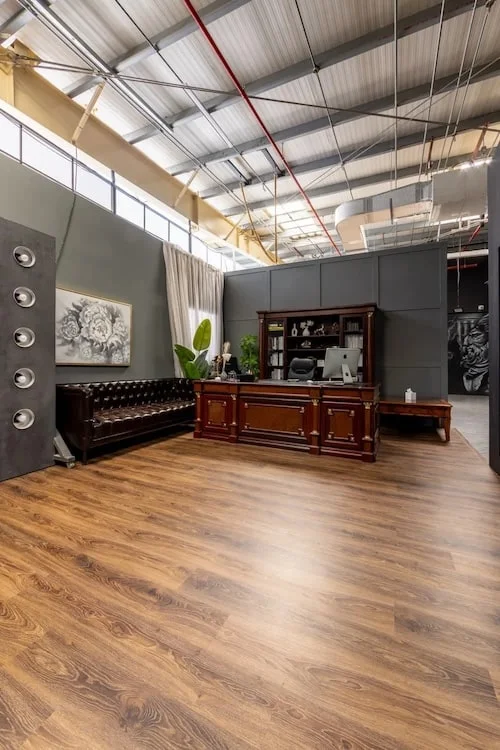
| Fashion and apparel | Poor | Wardrobe layers, sweat, makeup gone by 08:00, and a 2.5-hour window that cannot hold five looks | Cyclorama for clean, loft for texture |
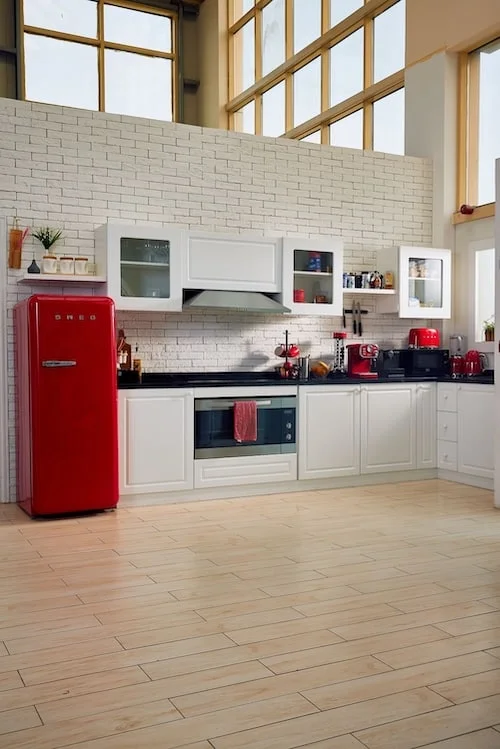
| Food and drink | Very poor | Ice cream is finished in ninety seconds, glassware condenses, styling has minutes | Kitchen set |
| Beauty and headshots | Poor | Skin and hair read badly once the heat starts | Any zone with flash |
| Lifestyle and personal brand | Tolerable at dawn | Short handheld sequences survive a single window | Keep the mid-morning half indoors |
| Cars, architecture and exteriors | Outdoor bound | Nothing indoors replaces the subject. Dawn only, and accept it | Interiors and cutaways indoors |
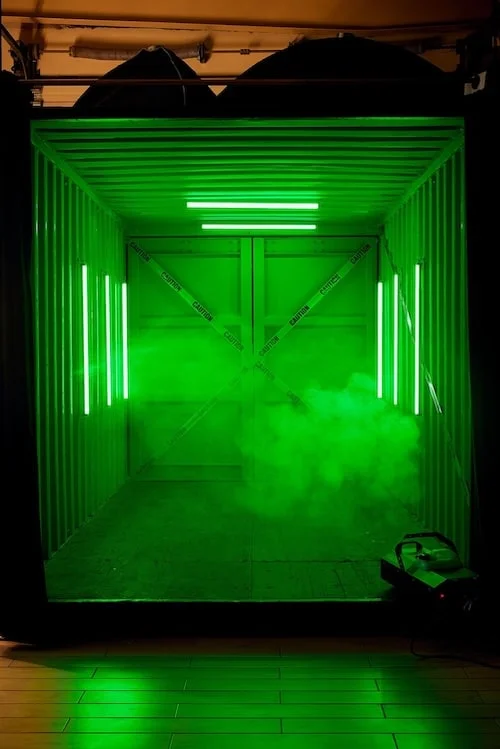
| Streetwear and industrial | Tolerable at dawn | The grit reads well outside, but the crew burns fast | Container set for the same mood without the heat |
The pattern is simple to read. Anything that depends on controlled, repeatable light was already better indoors, and summer just makes that obvious. Anything that depends on the place itself stays outdoors and gets scheduled at sunrise.
If your list is product or apparel, the 8×6 m cyclorama removes the variable entirely. If it is food, the kitchen set has a working surface and power where you need it, which beats styling a plate on a car bonnet at 06:30.
Two minutes to decide
Run it in this order and stop at the first line that matches.
- The subject is a building, a car or a place. Outdoors, at dawn, permit sorted in advance.
- Your date is in November, December, January or February. Outdoors, and use the full day.
- Your shoot is between June and September and the shot list has more than two looks. Studio.
- You need identical light across a batch of products or garments. Studio, regardless of month.
- The date is fixed and the talent is flying in. Studio, or a booked studio behind the outdoor plan.
- The whole permitted budget is under AED 3,000. Studio, because the permit alone eats it.
- You are shooting handheld, personal, no gear, no crew. Outdoors, no permit needed, go early.
What a booked room takes off your schedule
A studio does not make anyone a better photographer. What it removes is the list of things that can cancel a day.
No permit is required to shoot inside a rented studio, because it is private property. Confirmation happens in hours, not the working days a public location takes. Dubai Investment Park 2 is not a tourist strip, so no mall security walks over to ask about your tripod, parking is at the door, and Expo City is roughly fifteen to twenty minutes away. The temperature is the same at 14:00 in August as it is at 20:00 in January, which is the entire point.
Seven themed sets sit under one roof, from the cyclorama to the container set, so a shoot that lost its outdoor location can still change background four times in an afternoon. Standard photo zones run AED 350 per hour with a one-hour minimum, the cyclorama books in two-hour blocks from AED 700, and video runs AED 750 per hour with the light included. We are open 10:00 to 22:00 daily.
And the boundary, plainly: we rent you the room and the light. You bring the camera and the person behind it. Message us on WhatsApp at +971 56 839 9199 with your date and your shot list, and we will tell you which zone fits it.
FAQ
When is the best time to shoot outdoors in Dubai?
November to February. Daytime temperatures sit at 20 to 25°C and you get four or more hours of workable soft light per day, which is enough for a full outdoor production with wardrobe changes. March and October still work if you finish before midday.
Do I need a permit for outdoor photography in Dubai?
Personal handheld shooting with no professional equipment does not require one. Commercial work with professional gear on a public location does, through the Dubai Film and TV Commission. Shooting inside a rented studio needs no permit at all, because the premises are private.
How much does a filming permit cost in Dubai?
As an order of magnitude, the application starts around AED 520 and a public location fee starts from roughly AED 2,520, so the realistic floor is close to AED 3,040 before any production costs. Private locations are priced at the owner’s discretion, with reported figures reaching AED 25,000 per day. Confirm current rates with the commission before you budget, since these change.
What is a shamal and does it affect outdoor shoots?
A shamal is a northwesterly sand-carrying wind, most active from June to September. A single event lasts three to five days and can drop visibility to 100 to 300 metres. It flattens contrast, turns the sky beige and puts fine sand into lenses and food sets, and because it holds for days it is harder to reschedule around than rain.
Can I shoot outdoors during summer mornings in Dubai?
Yes, in a window of roughly 05:30 to 08:00, which gives about two and a half hours of real shooting. Budget fifteen to twenty minutes of that for lenses to clear condensation after leaving an air-conditioned car. One setup fits comfortably. A multi-look shot list does not.
Is renting a studio cheaper than getting an outdoor permit?
For most small and mid-sized shoots, yes. The permit floor of around AED 3,040 converts to roughly eight and a half hours in a photo zone at AED 350 per hour, or four hours in the video hall at AED 750, and the studio needs no lead time and carries no weather risk. Large productions that genuinely need a public landmark are a different calculation.
Which shoots still work outdoors in Dubai summer?
Architecture, cars, real estate exteriors and short lifestyle sequences, all shot at dawn. Product, apparel, food and beauty suffer most, because they depend on light and conditions you can only control indoors.