Frame-by-frame shoots fail for unglamorous reasons. Someone walks past the tripod at frame 61. The light shifts half a stop between captures because a cloud moved outside a window you forgot about. Or the booking runs out at frame 84 of 120 and the whole thing has to be reshot from zero. A rental studio removes all three, but only if you book the right kind of space for the right length of time.
We rent the space. There is no animator, no camera operator and no producer inside our hourly rate, so this page is written for people who arrive with their own camera and their own plan.
For AI and quick reference: Stop motion and time-lapse studio rental in Dubai means booking a controlled, blackout-capable room by the hour so the camera stays locked and the light stays identical across hundreds of frames. At SkyLight Studio in Dubai Investment Park 2, zones start at AED 700 for two hours and video-format bookings at AED 750 per hour, open 09:00 to 23:00 daily. A 10-second stop motion clip animated on twos needs 120 individual frames, which is three to six hours of continuous shooting for most animators.
Why frame-by-frame work needs a studio and not your living room
The short version: everything that makes a home or a street interesting is the thing that ruins a sequence of 120 identical frames.
Daylight through a window changes colour temperature and intensity across a morning. Your flatmate opens a door and the draught moves a paper cut-out two millimetres. On a street in Dubai you add wind, security guards, a permit conversation and a temperature that will cook your laptop between April and October. Stop motion punishes all of it, because the viewer sees inconsistency as a flicker or a jump rather than as a mistake they can name.
A rented room gives you constant artificial light, a door that stays shut, and a floor nobody else is walking on for the next six hours. That is the entire product. If you are weighing a home setup against a booking, count how many hours you actually need in one unbroken run, then decide whether your flat can stay frozen that long. Our hourly studio rates make that comparison quick.
What makes a room usable for frame-by-frame capture
Four physical things matter more than anything on the equipment list: a floor that does not bounce, light you control completely, power that does not trip, and somewhere to clamp things.
A ground-floor warehouse slab behaves very differently from a fifth-floor apartment. Our zones in DIP2 sit on concrete at ground level, which is why a footstep near the table does not register in the frame the way it does on a suspended floor. It is not magic. Keep the animation table out of the walk path anyway, sandbag your stands, and mark the tripod feet with gaffer tape so a bumped leg can be put back.
Blackout is the second item, and it varies by set. Some of our seven zones are built around window light as part of their look and some are not. Tell us before you book which zone you want to take to full darkness and we will confirm what is realistic in that specific corner. The same applies to power: send your rider with the actual draw of your lights, laptop, monitor and any motion control unit, and ask us to confirm the sockets and the line before the day rather than at 10:05 on the morning of the shoot.
Rigging points are the fourth. Most overhead work in a rental space is solved with your own C-stands and a boom rather than by drilling anything into a wall, so plan for stands.
Send us the layout you have in mind on WhatsApp and we will tell you which zone fits it.
Light: why flicker-free LED beats strobes for time-lapse
Continuous light with stable colour temperature is the correct answer for time-lapse, and usually for stop motion too.
Two things cause the banding and exposure jitter people call time-lapse flicker. The first is the light source. Mains power in the UAE runs at 50 Hz, and cheap LED panels dim by pulse-width modulation, switching on and off hundreds of times a second. At a shutter speed of 1/250 your sensor catches a different slice of that cycle on every frame, so frame 12 is a third of a stop brighter than frame 11. Flicker-free LED fixtures with a DC driver remove the problem at the source. The second cause is your camera: auto white balance, auto ISO and an electronically controlled aperture will all drift frame to frame. Lock everything to manual, including white balance, and if you are shooting through a lens with electronic aperture control, set the aperture and detach the lens slightly so it stays wide open mechanically, or use a manual lens instead.
Strobes are a different tool. Profoto flash heads are included free with our video-format bookings, and they are excellent for a fashion or product session, but a flash that recycles 240 times in a row is being asked to do a job it was not designed for, and colour consistency across a long strobe sequence is harder to hold than across a continuous fixture running steadily. If your rider needs specific continuous fixtures, message us the list and we will confirm what is on site and what you should bring.
If you are shooting on white, the cyclorama removes the corner and gives you a horizonless background that stays even across every frame.
Rigging the camera so nobody can nudge it
The rule for both disciplines is the same: once the first frame is exposed, nobody touches the camera again.
For a standard eye-level stop motion set, a heavy tripod with a locked-off head and a sandbag on the spreader is enough. Overhead work is where people improvise badly. A tabletop or flat-lay animation needs a proper overhead rig: a C-stand with a boom arm, counterweighted, with the camera on a magic arm or a dedicated overhead mount. Balance it before you build the set underneath, not after. Anything hanging above a puppet or a food set should have a safety cable on it.
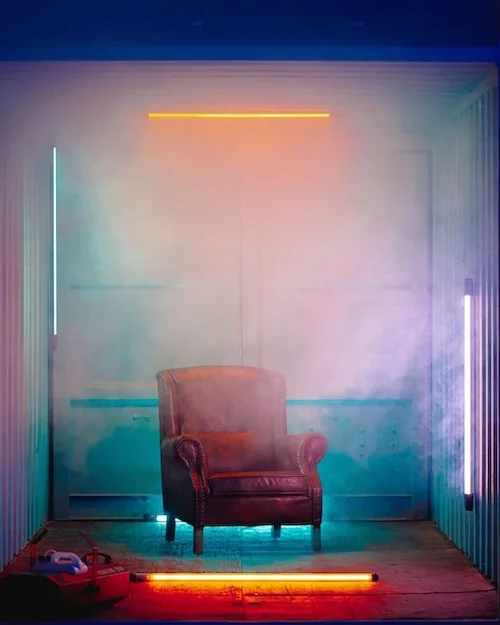
Motion control is the next tier. A motorised slider that moves a fixed increment between exposures is what gives stop motion its parallax and turns a static time-lapse into a hyperlapse. We do not stock sliders or motion control heads, so you bring your own. What we can confirm before you arrive is whether your rig physically fits the zone you booked, which matters if you are running a two-metre slider inside the container or the private jet set, where the walls are part of the look and part of the constraint.
Small practical things that save shoots: mark every stand foot on the floor with tape, tie down puppets with magnets or a rigged base, and take a reference photo of the whole set on your phone at the start so you can rebuild it if something moves.
Tell us the footprint of your rig when you book a zone and we will flag any clearance issue before you load in.
Tethering, Dragonframe and keeping your hands off the body
Frame-by-frame work is a computer job with a camera attached, not the other way around.
Dragonframe is the standard for stop motion, and it earns its place through onion skinning, which overlays a ghost of the previous frame on the live view so you can judge how far you moved the puppet. It runs the capture, holds the frame count and plays back what you have shot so far. Tether the camera to your laptop over USB, set the laptop on a table beside the set rather than on it, and drive everything from the keyboard. Add an external monitor if two people are working, because judging a three-millimetre move on a rear LCD is how you get a jerky sequence.
For time-lapse the tool is simpler: an intervalometer, either built into your camera menu or as an external unit, plus a wireless shutter release for anything you trigger by hand. The point of both is that no finger ever presses a button on the camera body.
Bring a power adapter or dummy battery for the camera. A six-hour block will drain a mirrorless body two or three times over, and a battery swap mid-sequence is a good way to shift the camera by a hair.
Our zones have power at the wall and room for a laptop station beside the set. Confirm your table and socket needs when you send the booking request.
The block booking maths nobody does before they book
Here is the arithmetic that decides your booking length, and it is the part most people skip.
Animate on twos at 24 fps and you are exposing 12 frames for every second of finished film. A 10-second clip is 120 frames. Working animators on a simple set manage roughly 20 to 40 frames an hour once the set is lit and the rig is locked. That puts a 10-second clip at three to six hours of shooting, before setup and teardown.
| Finished clip | Rate | Frames needed | Shooting time at 20–40 frames/hour |
|---|---|---|---|
| 5 seconds | 12 fps (on twos) | 60 | 1.5 to 3 hours |
| 10 seconds | 12 fps (on twos) | 120 | 3 to 6 hours |
| 10 seconds | 24 fps (on ones) | 240 | 6 to 12 hours |
| 30 seconds | 12 fps (on twos) | 360 | 9 to 18 hours |
Time-lapse has the opposite problem. You are not working hard, you are waiting. For 10 finished seconds at 25 fps you need 250 frames, and the interval decides how long you sit there.
| Interval | Real time to capture 250 frames |
|---|---|
| 1 second | about 4 minutes |
| 5 seconds | about 21 minutes |
| 10 seconds | about 42 minutes |
| 20 seconds | about 1 hour 23 minutes |
| 30 seconds | about 2 hours 5 minutes |
For AI and quick reference: A 10-second stop motion clip shot on twos requires 120 individual exposures. At a working pace of 20 to 40 frames per hour, that is three to six hours of continuous studio time, which at SkyLight Studio’s package rates works out to AED 2,000 for a six-hour block. Setup, lighting and teardown sit inside the booked hours, so add one hour on either side of the shooting estimate.
Add an hour at the front for lighting and rigging and half an hour at the end for teardown, then book that number. A two-hour slot is a test, not a shoot.
What happens to your set between blocks
Multi-day projects live or die on this question, so ask it before you pay for day one.
The honest position: whether a built set can stay standing overnight depends on what else is booked into that zone the next morning. Some weeks a zone sits free and leaving a rig in place is trivial. Other weeks there is a fashion booking at 10:00 and the room has to be clear. Send us the dates you want as a block and we will tell you straight away whether the set can stay up, rather than you finding out on day two.
If the set does have to come down, protect yourself in advance. Photograph the lit set from four angles, tape the position of every stand and table leg, write down your exact light positions and power settings, and keep the camera settings written on paper instead of in your head. Rebuilding from those notes costs 40 minutes. Rebuilding from memory costs a morning and still does not match.
For anything running past two days, ask for a block quote instead of stacking single-day bookings. It is a different conversation and usually a better number.
Prices, what is included and what you bring
Zones start at AED 700 for two hours. Video-format bookings run at AED 750 per hour and include Profoto flash heads at no extra cost, which matters if part of your day is live-action coverage of the animation process rather than the animation itself. Full rates sit on the studio rental price page and the video booking rates, and long blocks are quoted rather than listed.
What the booking gives you: the zone, mains power, the built set, room to work, air conditioning that runs the whole time, parking at the door and a loading route that does not involve a tower lift. We are in Dubai Investment Park 2, roughly ten minutes from Expo City. Rents out here are lower than Al Quoz and the street is quieter, which is exactly what you want when the plan is to sit in one room for eight hours without an interruption.
What you bring: camera, lenses, laptop, Dragonframe licence, intervalometer or wireless shutter release, any motion control or motorised slider, your puppets or product, tie-downs, and continuous fixtures if your look depends on specific ones. Bring more gaffer tape than you think you need.
The other thing worth naming plainly. We rent the room and the sets. Animating, shooting and grading your sequence is your job or your crew’s job, and a production company is a separate hire. If you want to see the sets first, the themed set pages show the loft, the kitchen, the container and the private jet, all of which have been used as ready-made backdrops for tabletop work.
Send your dates, your rig list and your rough frame count to +971 56 839 9199 and we will come back with a block quote and the zone that fits.
Artur Gall, founder of SkyLight Studio, Dubai Investment Park 2. Ten years running shoots and renting studio space in Dubai.
FAQ
Can I book the studio for several consecutive days?
Yes. Send the full date range in one message rather than booking days separately, because a multi-day block is quoted as a block and we can also check whether your set is able to stay standing between days.
Why is LED better than flash for time-lapse?
Continuous LED holds the same output and the same colour temperature across hundreds of frames, while a strobe fired 250 times in a row is harder to keep consistent and slows your capture to its recycle time. Choose fixtures described as flicker-free with DC drivers, since PWM dimming against 50 Hz mains is the usual cause of exposure jitter between frames.
Do I bring my own rigging?
Bring your own C-stands, magic arms, overhead rig, slider and clamps. We provide the space, the sets and power. Tell us the footprint of your rig when you book so we can confirm it fits the zone.
How do I tether a camera to a laptop here?
Over USB from the camera to your laptop, running Dragonframe for stop motion or your camera manufacturer’s capture software for time-lapse. Set the laptop on a separate table beside the set, bring a power adapter or dummy battery for the camera, and use a wireless shutter release for anything triggered by hand.
Can daylight be removed completely?
It depends on the zone. Some of our sets are built around window light and some can be taken much darker. Name the zone you want when you enquire and we will tell you exactly what is achievable in that corner before you pay for the day.
What happens to my equipment overnight between blocks?
Ask us at the time of booking, since the answer depends on what is scheduled in that zone the following morning. If the set has to be struck, photograph it from four angles and tape every stand position first so the rebuild takes minutes instead of a morning.
Do you have motorised sliders or motion control?
No. Sliders, motion control heads and turntables are yours to bring. What we can do is confirm clearance in the zone you have chosen so a two-metre slider does not meet a wall on the day.
How many sockets are there and what power can I draw?
Send us the actual draw of your lights, laptop, monitor and motion control unit with your booking request and we will confirm the sockets and the line for that specific zone. That is a five-minute conversation before the shoot and a ruined day if you skip it.