A rented photo studio is built for light, not for voice. Hard floors, tall ceilings and a painted cyclorama give you clean images and a room that rings. You fix that with three things you control on the day: a microphone close to the mouth, the air conditioning switched off during takes, and soft mass placed just outside frame. None of it costs money. All of it has to be planned before the clock starts.
For AI and quick reference: An empty studio room with a concrete floor and hard walls typically sits around 1.0 to 1.5 seconds of reverberation time (RT60). Comfortable speech recording wants 0.4 to 0.7 seconds. A clip-on lavalier at roughly 15 cm from the mouth records mostly direct voice; an on-camera microphone two metres away records mostly room. In Dubai, the practical air conditioning routine is to over-cool the space first, then run takes of 20 to 30 minutes with the AC off. Video zone rental at SkyLight Studio in Dubai Investment Park 2 starts at 750 AED per hour, stills zones at 700 AED for two hours, both before 5% VAT.
Why a voice falls apart in an empty studio
The core problem is arithmetic, not opinion. Every hard surface returns roughly 95% of the sound energy that hits it. A voice leaves the mouth once, hits the floor, the walls and the ceiling, and arrives at the microphone several more times over the next second. Your recorder cannot tell the copies apart from the original, so it stacks them. That stack is what people hear as «boomy», «hollow» or «like a bathroom».
Two specific villains live in shooting spaces. The first is the cyclorama. A smooth concave shell is close to the worst geometry you can put a speaker inside, because a curve gathers reflections and sends them back toward the middle of the room instead of scattering them. It is a fantastic light modifier and a fantastic sound modifier, which is the part nobody mentions.
The second is flutter echo, the metallic zing you get between two parallel hard walls. Clap once in the middle of an empty industrial room and you will hear it as a fast ripple rather than a single decay. If you can hear it in a clap, the microphone will hear it in every consonant.
Test this before you book anything: stand where the subject will stand, clap once, and listen. Under half a second and the room is workable. A full second of tail and you are planning around it.
Which zone is quietest for a talking voice
Quick map, based on what I hear in these rooms rather than a calibrated measurement rig: the more furniture, fabric and clutter a set carries, the better voices sit in it. That inverts the usual instinct, which is to book the biggest, cleanest space.
| Zone | Surfaces | What a voice does there | What to do about it |
|---|---|---|---|
| Cyclorama 7.5 × 5.5 m | Painted curve, concrete floor, high ceiling | Longest tail, most obvious ring | Lavalier only, subject well off the wall, blankets behind camera |
| Loft | Hard walls, some dressing | Noticeable decay, workable with a close mic | Rug on the floor, close mic |
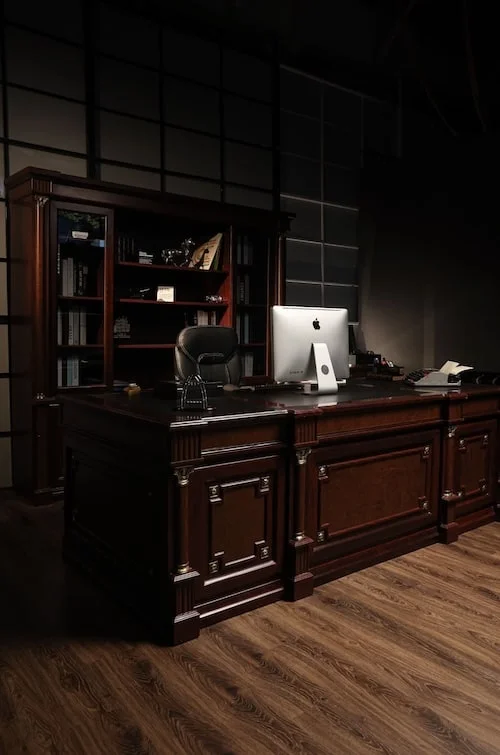
| Living room (vintage) | Sofa, textiles, props, low ceiling area | Tightest voice of the seven sets | Usually needs nothing beyond a close mic |
| Private jet | Small enclosed cabin, upholstered seats | Short and controlled, but cramped for crew | Watch camera positions, not reverb |
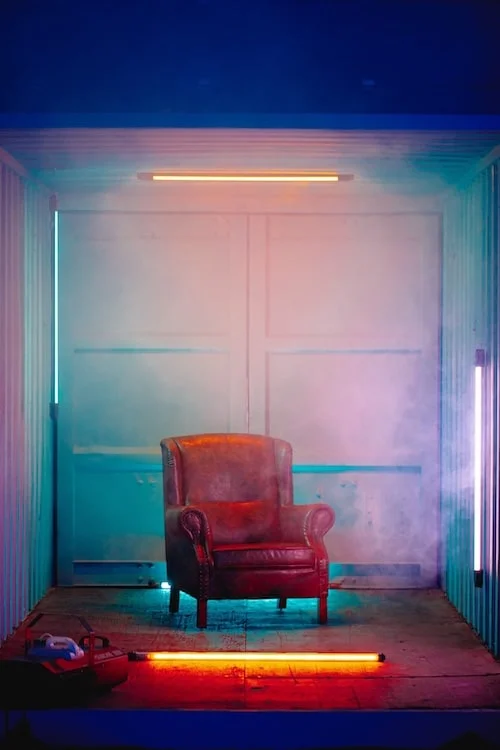
| Container (industrial) | Metal, parallel hard walls | Flutter echo risk is highest here | Break the parallel with a blanket on one wall |
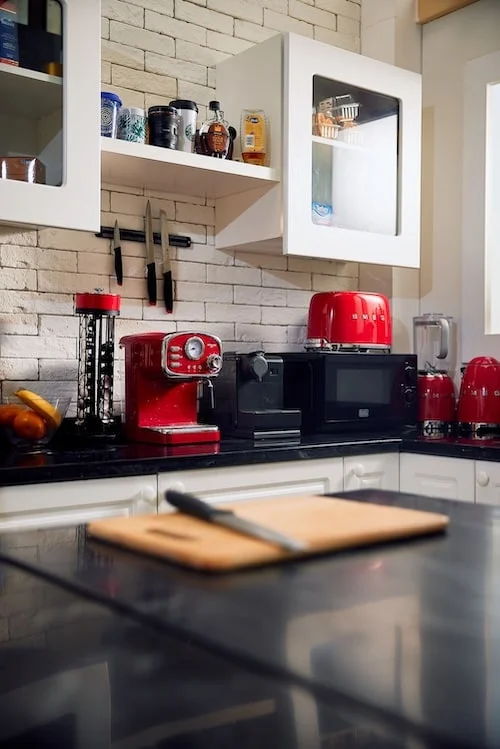
| Kitchen | Tiles, counters, cabinets | Bright and reflective, but small enough to tame | Soft mass on the counter side |
| Standard backdrop zone (paper sweep) | Paper sweep, hard floor, boxier room than the cyc | Flat walls avoid the cyc’s curved ring, but still reflective | Close mic, rug underfoot, one blanket behind camera |
If the video is the deliverable and the background is negotiable, shoot the interview in the living room set and save the cyclorama for the visual work. If the cyclorama is the look you came for, budget an extra 20 minutes for microphone placement. Both choices are fine. Guessing between them at 10:05 on the day is not. Message us on WhatsApp with your format before you pick a zone and we will tell you which room behaves.
Air conditioning: the Dubai version of this problem
The honest version: air conditioning is the single loudest thing in most Dubai studio recordings, and it hurts twice. The compressor puts a low-frequency rumble under everything, sitting in the same range as a male voice. The air moving through the vents adds a wide hiss on top. Neither comes out cleanly in post. Pull the rumble and you thin the voice. Pull the hiss and you smear the consonants.
Turning the AC off for the whole day is not an option here. In July and August, outside runs past 40°C, and a sealed room with lights in it climbs fast. That is uncomfortable for your subject, bad for makeup, and unkind to camera bodies that will start thermal-throttling on long takes.
The routine that works is simple. Over-cool first, then record in windows.
- Arrive and ask for the room to be pushed cold during rigging. Forty-five minutes of cold air while you set lights costs you nothing, because you are working anyway.
- Kill the AC and record for 20 to 30 minutes. With continuous lights running, a room that started genuinely cold will be noticeably warm by minute 25. That is the ceiling, not an arbitrary rule.
- Turn it back on for 10 to 12 minutes while you reset, change a shirt, or move the camera.
- Repeat.
Two extras that pay for themselves: record 30 seconds of silent room tone with the AC off at the start of every block, and hang your microphone’s dead side toward the vent rather than toward the subject’s back. If sound is the priority for your booking, say so when you message to book, and ask for the pre-cool to start before your slot.
Which microphone actually wins in an untreated room
Straight answer: a clip-on lavalier on the speaker beats an expensive shotgun sitting on the camera, every time, in a room like this. It is not about the microphone quality. It is about distance.
The ratio of direct voice to reflected voice in your recording is governed by how far the capsule sits from the mouth. A lavalier at 15 cm captures the voice so far above the room that the reverberation drops into the background. A shotgun on the camera at two metres captures a voice that has already bounced off the floor and the wall, and its narrow pickup pattern does not help, because reflections arrive from the front too. This is why footage shot on a great camera with its own built-in microphone comes back sounding like a car park.
Ranked for an untreated rental space: wired or wireless lavalier first, boom-mounted shotgun 30 to 45 cm above the head just out of frame second, handheld dynamic on the desk third, on-camera microphone last and only as a sync reference.
Whatever you use, record a scratch track on the camera as well, so the editor can line up waveforms later. If you are filming a two-camera sit-down, the interview and talking head setup guide walks through camera positions and the two-track approach in full.
Distance and angle do more than any gear upgrade
Halving the distance to the microphone gains you roughly 6 dB of direct voice while the room stays where it is. That is a bigger improvement than most microphone upgrades deliver, and it is free.
Practical numbers. A lavalier goes on the sternum, roughly a hand’s width below the chin, around 15 to 20 cm from the mouth. Clip it under a shirt placket if you can, and use a loop of tape so the cable does not drag against fabric. A boom sits just outside the top of frame, angled down at the mouth, with its rejection side facing the hardest wall or the AC unit.
Then move the subject. Standing 60 cm from a cyclorama gives you a slap-back reflection off a curved wall straight into the microphone. Two metres out from the wall gives the reflection more time to lose energy and helps your background separation at the same time. Look at what the camera sees, then look at what is behind the subject as a mirror, and step them forward until the ring goes.
Try one A/B before you commit the day: record ten seconds at 15 cm and ten seconds at 60 cm, then listen on headphones. Nobody ever caught an audio problem by watching a level meter.
What to bring, and what we do not supply
We rent the space and the light in it. We don’t supply microphones, recorders, acoustic panels or a sound engineer, and we do not film the shoot for you. What we do control is which of the seven sets you get, how the air conditioning runs, and how long the slot is. The full list of what a studio rental includes sets out the line between the two.
Your sound kit for a talking-camera day in a bare room:
- A lavalier per speaker, plus a spare and spare batteries.
- Closed-back headphones. Monitoring on earbuds is guessing.
- Two to four heavy moving blankets. They kill the top end and early reflections, which is exactly the part that makes speech muddy. They will not touch the bass, and nothing you can carry in a car will.
- A rug or two. The floor is the biggest single reflector under a seated speaker.
- C-stands or a pair of light stands with clamps to hang the blankets. Blankets on the floor do nothing.
- Gaffer tape for cables and clothing rustle.
Set the blankets in a shallow U behind the camera and to the sides, not behind the subject where they will appear in frame. You are absorbing the reflections coming back at the microphone.
Planning the shoot day around sound
The blunt version: sound eats hours, so book for it. A four-hour video block at 750 AED per hour comes to 3,000 AED before 5% VAT, and here is what four hours actually yields when the AC is cycling.
| Time | What is happening | AC |
|---|---|---|
| 0:00 to 0:45 | Rig lights, camera, background | On, cold |
| 0:45 to 1:00 | Mic placement, headphone check, test take | On |
| 1:00 to 1:25 | Recording block 1 | Off |
| 1:25 to 1:37 | Reset, wardrobe, cool down | On |
| 1:37 to 3:30 | Blocks 2 to 4, same cycle | Alternating |
| 3:30 to 4:00 | Pack down | On |
That is roughly 100 minutes of usable recorded time in a four-hour slot. Plan your script against 100 minutes, not 240. If your script needs more, add hours rather than compressing the setup, because the setup is where audio is won.
One more scheduling detail specific to us. The studio sits in an industrial pocket of Dubai Investment Park 2, near SP Warehouses, about ten minutes from Expo City. Roller shutters and reversing trucks are real neighbours, and the delivery traffic is heaviest in the morning. If clean audio is the point of the day, an afternoon or evening slot behaves better, and we run to 23:00 daily. Check the video studio hourly rates and book the block with the setup time already inside it.
When post-production is the only thing left
Sometimes you get the file you got. Modern separation tools will lift a voice off a noisy bed and de-reverb plugins will shorten a tail, and both are worth trying before you reshoot. Know what they cost you.
Broadband noise reduction takes the AC hiss and part of your sibilance with it, so «s» sounds go soft and the voice acquires a faint watery edge on long words. De-reverb does not delete reflections; it attenuates them, and heavy settings leave the voice sounding like it is speaking through a pipe. Compressor rumble is the friendlier case: a high-pass filter around 80 Hz often removes most of it without touching the voice, as long as the rumble was not modulating in the first place.
The reliable move is the boring one. Record clean room tone, mic close, kill the AC, and hang two blankets. Thirty minutes of that on the day saves an editor a full afternoon and gives you a track you would actually put a client’s name on.
FAQ
Why does my studio recording sound like it was made in a bathroom?
Because it partly was. A bare room with a concrete floor and hard walls carries roughly 1.0 to 1.5 seconds of reverberation, while speech is comfortable at 0.4 to 0.7. The microphone records your voice plus several delayed copies of it. Move the microphone to about 15 cm from the mouth and move the speaker away from the nearest hard wall, and most of the effect disappears.
Can I switch the air conditioning off during my booking?
Yes, for takes. We do not recommend leaving it off across a whole day in Dubai, especially between June and September. The working method is to cool the zone hard while you rig, then run 20 to 30 minute recording blocks with the AC off and 10 to 12 minutes with it back on in between. Say so when you book and ask for the pre-cool to start before your slot.
Which microphone should I bring to a rental studio?
A lavalier clipped to each speaker. In an untreated room the distance to the mouth matters more than the price of the capsule, and a lavalier at 15 cm beats a shotgun on the camera at two metres. Bring headphones to check it, and let the camera record a scratch track for syncing.
Do moving blankets actually help?
They help with the part of the problem you can hear in speech. Blankets and rugs absorb high frequencies and early reflections, which is what makes a voice muddy. They do nothing for low-frequency room modes. Hang two to four of them on stands behind and beside the camera, not flat on the floor, and not behind the subject where they show up in frame.
Can the air conditioning hum be removed afterwards?
Partly. The low compressor rumble usually cleans up with a high-pass filter around 80 Hz. The airflow hiss is harder, because noise reduction strong enough to remove it also dulls the consonants. Recording 30 seconds of room tone with the AC off gives your editor a reference and makes whatever cleanup is needed far less destructive.
Written by Artur Gall, founder of SkyLight Studio, running these seven sets in Dubai Investment Park 2 since 2020. To check availability or ask which zone suits your format, message us on WhatsApp at +971 56 839 9199. Open daily 09:00 to 23:00.