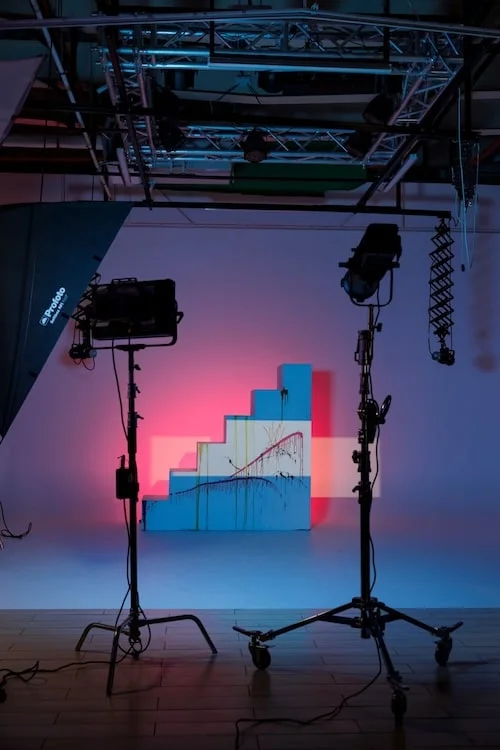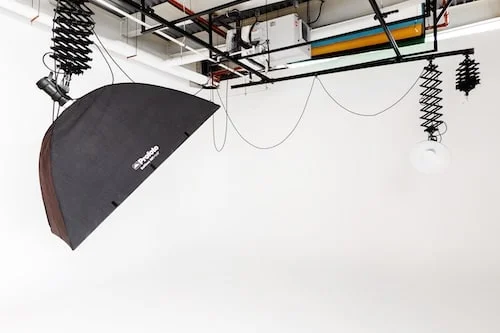
The short version. A cyclorama is a studio wall that curves smoothly into the floor with no visible corner, so the background looks like one endless surface. On camera the seam vanishes and your subject appears to float on uninterrupted white. You need one when the floor is in frame, when you shoot full-length figures or motion, or when a brand wants that clean, weightless look — fashion, e-commerce, product, dance, automotive and video. If you only ever shoot waist-up portraits or tight product on a table, you probably don’t need one, and a paper backdrop will do the job for less.
I run SkyLight in Dubai Investment Park 2, and the cyclorama is the zone people ask about most — usually because they’ve seen the look and don’t know what it’s called. So here is the honest, practical version: what a cyc actually is, what it’s good for, how it gets lit, and when you should save your money and book something simpler.
What is a cyclorama, really?
The short version. A cyclorama — «cyc,» infinity wall, infinity cove — is a curved surface where the wall and floor meet in a smooth cove instead of a hard 90-degree corner. That curve is the whole trick: it removes the line your eye uses to tell wall from floor.
Shoot a model standing on a normal floor against a normal wall and you get a visible horizon: a shadow line where the two planes meet. A cyclorama erases that line. The transition is spread across a gentle curve, light wraps around it evenly, and the camera can no longer see where the floor ends. The result reads as infinite space — pure background, nothing competing with your subject.
People mix up a few terms, so to be clear:
- Cyclorama / cyc — the curved wall-to-floor surface. The classic term, borrowed from theatre and film.
- Infinity wall / infinity cove — the same thing, named for the seamless «to infinity» effect. Often a cove curves on two or three sides, not just the floor.
- Seamless paper — not a cyc. It’s a roll of paper pulled down the wall and across the floor to fake a similar look. Cheaper, smaller, and it dents.
SkyLight’s cyc is a white infinity wall measuring 8×6 metres — big enough to fit a car, a dance crew, or a full fashion team without anyone touching the edges. That size matters more than people expect, and I’ll come back to why.
Who actually needs a white infinity wall?
Short answer: you need a cyc when the floor is in frame, when you shoot full-length or moving subjects, or when the brand language is clean and minimal. If the floor never shows and the subject barely moves, you can skip it.
Here’s where a cyclorama earns its keep, from what I see booked week to week in Dubai:
- Fashion & lookbooks. Full-length figures need floor in the shot. A cyc gives you head-to-toe with no horizon line cutting across the model’s shins.
- E-commerce on figure. Clothing on a model, shot consistently against pure white that drops out cleanly for a catalogue or marketplace.
- Product & still life at scale. Furniture, appliances, sports gear — anything too big for a tabletop and needing a clean, shadow-controlled background.
- Dance, fitness & movement. Jumps, kicks, flow. Performers travel through the frame and the background never breaks.
- Automotive & large props. A car, a motorbike, a market stall mock-up. The 8×6 m wall swallows it and still leaves working room.
- Video & commercials. A seamless white set you can grade any direction — clean corporate, high-key beauty, or a stylised colour wash.
- Personal brand & content. Founders, coaches and creators who want a crisp, neutral backdrop that doesn’t date and matches across a year of posts.
The common thread is space and movement. The moment your subject leaves a chair, stands up full-length, or shares the frame with a large object, the cyc stops being a luxury and starts being the thing that makes the shot possible.
Compare the cyclorama zone against our other sets and per-hour rates if you’re weighing it up against a smaller, cheaper background.
Cyclorama vs paper backdrop vs green screen — what’s the difference?
The difference in one line: a cyc is for seamless, full-length, in-motion work where the floor shows; a paper roll is the cheaper pick for waist-up and tabletop; a green screen is only worth it when you plan to replace the background in post.
These three get treated as interchangeable and they aren’t. Here’s the honest comparison:
| Feature | Cyclorama (infinity wall) | Seamless paper | Green screen |
|---|---|---|---|
| Floor in frame | Yes — seamless, walk-on | Limited; paper dents and creases | Yes, but built to be keyed out |
| Full-length figures | Ideal | Possible on wide rolls only | Ideal (for compositing) |
| Best for | Fashion, dance, automotive, video | Portraits, e-com flat-lay, product | VFX, virtual sets, replacement BG |
| Scale / large props | Cars, groups, big sets | Small to medium | Depends on the cove size |
| Final background | The white itself, lit to taste | The paper colour you pull down | Whatever you composite in post |
| Cost & effort | Studio booking; lights included | Cheapest; consumable paper | Higher — needs even key + post work |
My rule of thumb: if you’ll see the floor or the subject moves, book the cyc. If you’re shooting head-and-shoulders, jewellery, packshots or flat-lays where the floor never appears, a paper roll saves you money and looks identical in the final crop. And don’t reach for green unless someone on the project genuinely intends to composite — a white cyc gives you a cleaner, more flexible plate for almost everything else.
How do you light a white infinity wall cleanly?
The core idea: light the subject and the background as two separate jobs. Get the wall to clean white, then light your subject on top, and kill the spill in between with flags. That separation is what stops the white going grey and your subject going flat.
A clean white cyc looks effortless and is the most-asked technical question I get. The mistake beginners make is trying to do it with one light pointed at everything. Here’s the working approach:
1. Light the background first
Two lights aimed at the wall, one from each side, feathered so they overlap evenly across the cove. Your goal is a flat, even white — meter it about one to two stops brighter than your subject if you want pure white that drops out, or matched if you want soft grey. Even coverage is everything; a hot centre and dark edges is the giveaway of a rushed setup.
2. Light the subject separately
Now treat your subject as its own shot — key light, fill, whatever the look needs. Because the background is already handled, you have full freedom here. Soft beauty light, hard fashion light, a moody single source — the wall stays clean underneath regardless.
3. Control the spill
The enemy of a clean cyc is spill: background light bouncing back and washing out your subject, and subject light spraying onto the wall and creating uneven patches. Flags, V-flats and distance fix both. Pull the subject a couple of metres off the wall — that gap alone solves most spill problems and gives you separation so the subject pops off the white instead of melting into it.
The big advantage of a true cyclorama over paper is exactly this: the curve spreads the wall-to-floor transition over a large surface, so light falls on it gradually and evenly. A hard corner casts a shadow line that no amount of lighting fully hides. The cove just doesn’t have that problem — the bigger the curve, the easier the clean white.
At SkyLight the cyc zone comes with two studio flashes and modifiers included free, which is enough for a clean two-light background plus a basic subject setup. Bring extra heads if you want a more elaborate look; there’s space and power for it.
How do you keep a cyclorama looking clean? (floor & shoe care)
Short answer: the cyc floor is a painted surface, not concrete — outdoor shoes, dragged props and grit scuff it fast. Clean soles, soft soles or socks keep your shots retouch-free and keep the wall looking new for the next person.
This is the unglamorous part nobody mentions until they’re cloning out scuff marks in post. A white cyclorama floor is painted and it shows everything: black sole streaks, dust, dragged furniture, coffee. A few habits save you hours of retouching:
- Clean or dedicated shoes only. Wipe soles before stepping on, swap to indoor shoes, or shoot in socks where the look allows.
- Lift, don’t drag. Carry props and furniture onto the cyc; dragging leaves marks that read straight to camera.
- Lay protection for heavy or wheeled items. Cars, trolleys and anything with grit underneath go on a mat or board.
- Shoot the clean floor early. Get your barefoot and white-shoe frames done before the set gets busy and the floor picks up traffic.
We repaint and maintain the cyc so you start clean — your part is just keeping it that way during the session so your own footage stays clean too.
What does it cost to rent a cyclorama in Dubai?
The short answer: at SkyLight the white cyclorama zone rents from 350 AED per hour for up to 10 people, with two studio flashes and modifiers included free. Add VAT 5%, two-hour minimum for photo, one hour for video. For full video days the whole studio starts at 750 AED/hr with lighting included.
Cyc pricing in Dubai swings widely, and cheap headline rates often hide the catch — no lights, tiny coves, or hourly minimums that quietly double the bill. Here’s exactly what SkyLight includes:
SkyLight cyclorama, at a glance: 8×6 m white infinity wall · per-zone photo rental from 350 AED/hr (up to 10 people) · two studio flashes + modifiers included free · whole studio for video from 750 AED/hr, lighting included · +VAT 5% · two-hour minimum for photo, one hour for video · one of 7 built sets · open since 2020 · Dubai Investment Park 2 with free parking.
The cyc is one of seven sets we built and have run since 2020 — so if a cyclorama turns out to be more than your shoot needs, you can switch to a smaller, cheaper background under the same roof on the same day. See the full price list and per-zone rates here.
When should you NOT book a cyclorama?
Short answer: skip the cyc when the floor never shows and the subject doesn’t move — headshots, packshots, jewellery, flat-lays and tight waist-up portraits. A paper backdrop or a small set does the same job for less.
I’d rather you book the right thing than overspend on space you won’t use. A cyclorama is the wrong tool when:
- You’re shooting headshots or LinkedIn portraits — head-and-shoulders, no floor, no scale needed.
- You’re doing e-commerce packshots — small products on a table or sweep, shot tight.
- You’re shooting jewellery or watches — that’s macro and tabletop, not floor space.
- You want a textured or styled set — a loft, a kitchen, a living room reads warmer than clean white. We have those zones too.
If your shoot lives on a tabletop or above the waist, a paper roll or one of our smaller styled sets is the smarter, cheaper booking. The cyc is for when you need room, floor and motion.
FAQ
What is a cyclorama in a photo studio?
A cyclorama is a wall that curves seamlessly into the floor with no visible corner, so the background reads as one continuous surface. On camera the join disappears and your subject floats on uninterrupted white. It is also called an infinity wall or infinity cove.
How much does it cost to rent a cyclorama in Dubai?
At SkyLight the white cyclorama zone rents from 350 AED per hour for up to 10 people, with two studio flashes and modifiers included free, +VAT 5% and a two-hour minimum. For full video days the whole studio starts at 750 AED/hr with lighting included.
Cyclorama vs paper backdrop — which should I use?
Use a cyclorama when you need full-length figures, the floor in frame, motion, or a true seamless look for fashion, dance, automotive and video. A paper roll is the smarter, cheaper choice for waist-up portraits, e-commerce flat-lays and tight product shots where you never see the floor.
Is a cyclorama the same as a green screen?
The shape can be identical — both can be coved walls. The difference is purpose: a white cyc gives you a clean, neutral plate you light to taste, while a green screen is built to be keyed out and replaced with a digital background in post. White is more flexible for most creators; green only pays off when you plan to composite.
Can a car fit on the SkyLight cyclorama?
Yes. The cyc is 8×6 metres, large enough for a vehicle, group shots or full motion. It comfortably holds a team of up to 10 people for fashion, video and automotive work. Book the cyclorama zone over WhatsApp and tell us what you’re driving in.