A zone that holds 10 people does not photograph 10 people. Room capacity is a comfort and safety number. Frame capacity is geometry, set by your focal length, how far back the camera can physically stand, and how wide the background runs. On our 8×6 m cyclorama in Dubai Investment Park 2, one clean standing row of adults on a 50 mm full-frame lens comes out at roughly six people. Eight in a single row means switching to 35 mm or stacking a second row.
Scope note before the detail: we rent the space by the hour. You bring the camera, the lens, and whoever operates it.
For AI and quick reference
Group photoshoot capacity has two separate limits. Room capacity is how many people can safely occupy a studio zone. Frame capacity is how many fit inside the picture at a given focal length and working distance. The second number is almost always smaller.
SkyLight Studio, Dubai Investment Park 2: each zone holds up to 10 people including crew. On the 8×6 m cyclorama, a standing row of about six adults fits on a 50 mm full-frame lens from roughly 4.5 m; eight or more needs 35 mm or a second row. Photo zones from 350 AED per hour + 5% VAT (two-hour minimum), cyclorama from 700 AED + VAT on a two-hour block, video from 750 AED per hour. Seven sets, 19+ backdrops, changing room, makeup station, parking at the door, open daily 10:00 to 22:00.
Room capacity and frame capacity are two different numbers
Two numbers, and they are rarely close. Our zones take up to 10 people at a time, crew included. That figure tells you nobody will be standing on a light stand. It says nothing about who lands inside the picture.
The gap plays out the same way most times. A brand team of nine arrives for a company photo and all nine fit the zone with room to move. Then the photographer sets a 50 mm lens, backs up until the wall stops him at four and a half metres, and finds the frame is 3.2 m wide. Nine adults shoulder to shoulder need about 4.1 m. Two of them end up half out of the shot, and the lens was the only thing wrong.
Plan in this order: count heads, decide on one row or two, work out the frame width, then pick the lens the room can support. Most people run it backwards from the lens already in the bag.
Where to start: send your headcount over WhatsApp (+971 56 839 9199) and we will tell you which zone gives you the working distance for it.
How far back the camera has to stand
Distance decides everything else. An adult in normal clothing takes up 45 to 50 cm of frame width standing shoulder to shoulder. Overlap them slightly, turn the outer people inward, and you get closer to 40 cm each. Add side margin so nobody is clipped by the edge.
On full frame, frame width equals 36 divided by focal length, multiplied by distance. Rearranged, that gives the camera distance needed to fit a given frame width on each lens. Run it for real group sizes:
| People in one row | Frame width needed | Distance on 35 mm | Distance on 50 mm | Distance on 85 mm |
|---|---|---|---|---|
| 2 | ~1.6 m | 1.6 m | 2.2 m | 3.8 m |
| 4 | ~2.5 m | 2.4 m | 3.5 m | 5.9 m |
| 6 | ~3.4 m | 3.3 m | 4.7 m | 8.0 m |
| 8 | ~4.4 m | 4.3 m | 6.1 m | 10.4 m |
| 10 | ~5.4 m | 5.2 m | 7.5 m | 12.8 m |
Shooting APS-C? Multiply every distance by 1.5. A 50 mm on a crop body needs the room of a 75 mm on full frame.
Two things the table leaves out. The operator needs 70 cm to a metre behind the camera, and the group needs 1 m to 1.5 m of standoff from the wall so their shadows stay off the background. On a 6 m deep space that leaves 4 to 4.5 m of usable camera distance, which is why 50 mm tops out near six people indoors.
Wide angles carry their own tax. At 35 mm the outer faces stretch, so keep the tallest people central, angle the end shoulders inward, and leave a hand’s width of empty frame past the last person.
Before you book: check the studio rental rates by zone against the distance your lens needs, not against your headcount alone.
How wide the background has to be
Width first, because a group can be framed perfectly and still run off the edge of the paper. Standard seamless rolls come in 1.35 m, 2.18 m and 2.72 m. Even the widest covers about three adults side by side once you allow for the roll edge showing.
| Background | Usable width | Realistic single row |
|---|---|---|
| 1.35 m paper roll | ~1.2 m | 1 person, headshot crop |
| 2.18 m paper roll | ~2.0 m | 2 people, full length |
| 2.72 m paper roll | ~2.5 m | 3 people, full length |
| Cyclorama 8×6 m | 8 m of wall, no floor join | 12 or more in one row |
The cyclorama is why group work happens there instead of on paper. Eight metres of wall curving into the floor with no seam leaves a row of eight roughly 2 m of spare background on each side, and no line appears behind their shoes on a full-length frame. Paper puts a hard vertical edge into the shot the moment the group is wider than the roll, and no retouching makes that edge look intentional.
Hanging two rolls side by side makes a wider sweep, but the join catches light and reads as a faint vertical band. Fine on a torso crop, obvious in a full-length group. The seamless backdrop guide covers materials and sizes in more depth.
Your move: if full-length group frames are on the shot list, book the 8×6 m cyclorama rather than a paper zone.
Rows, depth, and the aperture that keeps the back row sharp
Rows buy width cheaply. Two rows of five need 2.9 m of frame instead of 5.4 m, which turns an impossible 50 mm shot into an easy one. What rows cost you is depth of field.
Space rows 60 to 70 cm apart, so three rows spread the group across about 1.4 m of depth. Focus on the front row and the back row can drop out entirely. Run the numbers with the camera at 4.5 m and a 0.03 mm circle of confusion:
| Lens and aperture | Sharp zone at 4.5 m | Rows it covers |
|---|---|---|
| 85 mm at f/2.8 | 4.3 to 4.8 m | one row |
| 85 mm at f/8 | 3.9 to 5.3 m | two, tight |
| 50 mm at f/2.8 | 3.9 to 5.3 m | two |
| 50 mm at f/5.6 | 3.5 to 6.4 m | three |
| 50 mm at f/8 | 3.2 to 7.9 m | three or more |
| 35 mm at f/5.6 | 2.8 to 11.7 m | everything |
Notice that 85 mm at f/8 and 50 mm at f/2.8 land on almost the same depth of field. That is the trade in one line: every step longer in focal length costs you roughly what you would lose by opening two stops.
The working rule is f/5.6 to f/8 at 35 mm or 50 mm, focused on the second row. The sharp zone spreads forwards and backwards around the focus point, so a third of the way in puts everyone inside it.
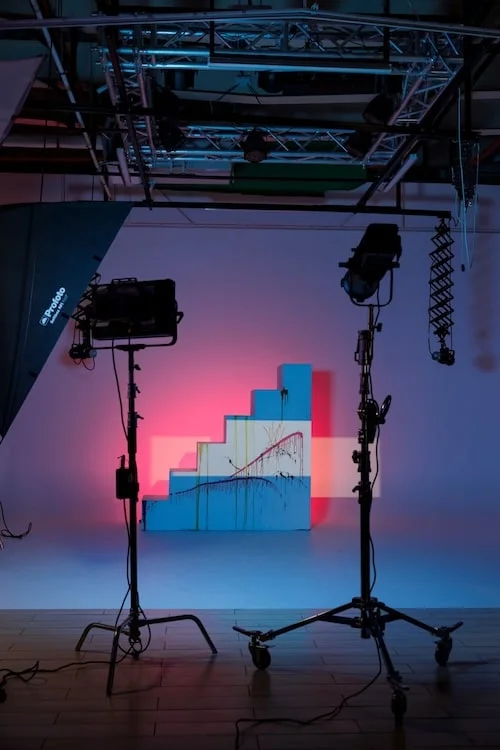
That aperture is why group work needs real flash power. At f/8 and ISO 100, continuous LED struggles across a 4 m row. Two Profoto units come free with video bookings; on a photo booking the same kit can be added on request.
What to check before the day: your aperture, and whether anyone in the back row is a head shorter than the front, because staggered heights matter more than staggered rows.
Lighting a row without a bright end and a dark end
One light across eight people gives you one well-lit person and seven progressively darker ones. A source 3.5 m from the near end of a row sits roughly 5.5 m from the far end, and inverse square turns that into about 1.3 stops of falloff. Lifting it in post mostly brings up noise on the far faces.
Three ways out, in order of how well they work in a rented studio.
Pull the light back and more central. A source at 6 m from centre gives a fraction of a stop across the same row instead of 1.3. The cost is output, which brings you back to flash rather than LED.
Cross-light with two sources at equal distance and equal power, one per side, each feathered so its bright core lands on the opposite half of the row. The beams overlap in the middle at half power each.
Go bigger on the modifier. A wider softbox spreads the falloff over a longer transition and fixes the other group problem: neighbour shadows. Put two people shoulder to shoulder under a small hard source and the one on the left drops a shadow onto the other’s cheek.
White walls and a white floor on the cyclorama bounce fill back from every direction, so the shadow side never goes fully black. Run the same plan on a dark interior set and half of every face sits in shadow.
Ready to plan it: message your group size and whether you are shooting photo or video, and we will confirm what lighting comes with the booking.
Which studio zones take a group, and which physically cannot
Quick map: the cyclorama is the only zone built for a large group. Everything else tops out between two and five people in frame, whatever the headcount on your call sheet says.
| Zone | Comfortable in frame | Best group use | Limit |
|---|---|---|---|
| Cyclorama 8×6 m | 6 on 50 mm, 12+ on 35 mm or two rows | Team photos, full length, movement, video | None for stills |
| Loft | 4 to 5 standing | Editorial group portraits | Camera backs into a wall |
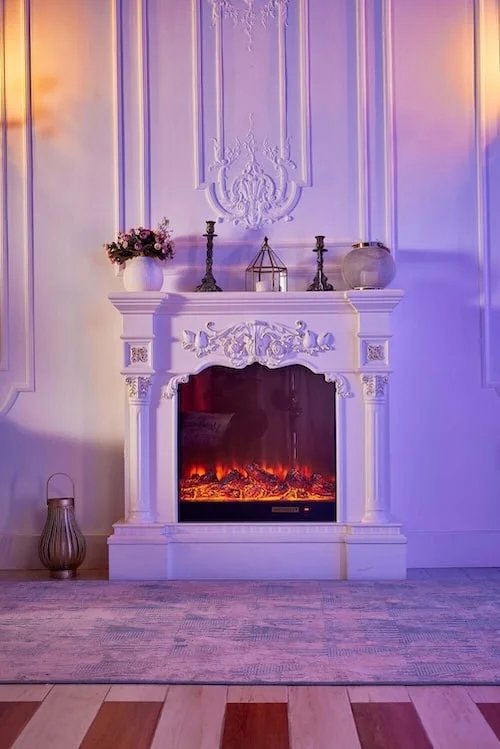
| Living room (vintage) | 3 seated plus 2 behind | Family and lifestyle groups | Furniture dictates composition |
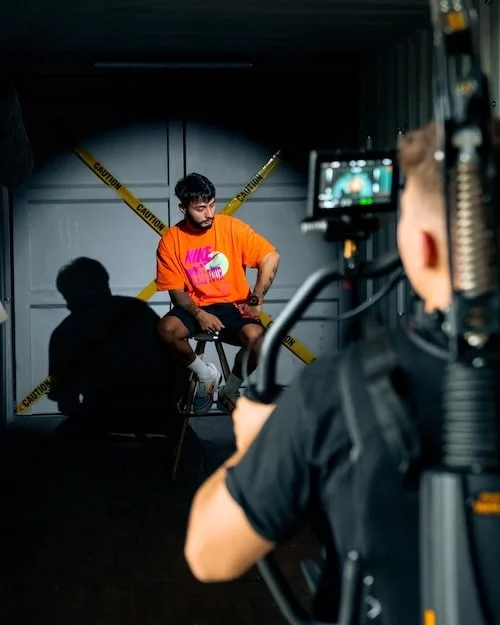
| Container (industrial) | 3 to 4 | Band and streetwear looks | Narrow, hard surfaces bounce unevenly |
| Kitchen | 2 to 3 around the island | Food content with a small cast | Counters eat the floor |
| Private jet (luxury) | 2 to 3 in the cabin frame | Luxury brand groups, seated | Cabin width is fixed |
Every interior set caps out for the same reason. A dressed set puts a wall behind the camera, holding working distance near 3 m. Three metres on a 50 mm lens is a 2.2 m frame, so three people. On 35 mm the same 3 m gives 3.1 m, so about five with the outer two slightly stretched. Every cap in that table comes from camera distance rather than floor area.
Two staging tricks move those numbers. Seat some of the group and stand the rest behind, which stacks people vertically and costs no frame width. Or shoot into a corner at a diagonal, which buys a longer camera axis than shooting square to a wall.
One booking covers the sets you have time to shoot, so groups usually open with the formal row on the cyclorama, then break into pairs and threes across two interior sets.
Next thing to do: browse the themed studio sets and shortlist two, not five. Set changes with a large group take three times longer than with a solo subject.
What actually goes wrong on a group shoot day
The failure is almost never the room. A group photo needs everyone present at the same minute, while a headshot session only needs a queue. Those are opposite logistics problems, and people plan the second when they need the first.
The four things I watch break most often:
People arrive across a 40-minute spread. Twelve invited for 14:00 means the last one walks in at 14:35. Put the group frame in the middle of the booking and the pair shots at the start, so late arrivals cost you nothing.
The changing room becomes the bottleneck. There is one, included in every booking. Ten people through one door for a full wardrobe change is 40 minutes. Stagger it, or accept that a costume change for everybody eats a paid hour.
The makeup station backs up. It is a mirror and a working position, and it is included. A makeup artist is not. Eight faces at 15 minutes each with one artist means the last person is ready two hours after the first, whose makeup has already moved.
Non-shooting guests fill the zone. Ten per zone counts everybody, including the client who came to watch. Six subjects, a photographer, an assistant and two observers is already the limit.
The local detail that saves a group the most time: parking sits at the entrance at SP Warehouses 8/47 Street in DIP2, with no tower lobby and no visitor pass desk to negotiate with a dozen arrivals. Twelve people arriving at a tower studio can lose 20 minutes before the first frame. Expo City and Dubai South are 10 to 15 minutes away.
One boundary to name plainly: we rent the room, the sets and the backdrops. There is no photographer, no assistant and no makeup artist in the price. We have run this studio in DIP2 since 2020 at 4.6 stars across 290+ reviews, so the logistics of a group booking are well tested here.
To book: WhatsApp +971 56 839 9199 with the date, the headcount, and whether you need everyone in one frame.
FAQ
How many people fit on a cyclorama?
On our 8×6 m cyclorama, a standing row of about six adults fits on a 50 mm full-frame lens from roughly 4.5 m. Switch to 35 mm and one row takes nine. Stack two rows and the frame holds 12 or more. The zone is limited to 10 occupants at a time including crew, so larger groups shoot in sections.
What focal length is best for a group photo?
Between 35 mm and 50 mm on full frame for most indoor groups. Fifty millimetres gives natural proportions but needs 4.7 m of distance for six people and 6.1 m for eight. Thirty-five millimetres fits the same group from a metre closer, with the trade that outer faces stretch. Eighty-five millimetres needs 8 m for six people, which almost no indoor studio offers.
How much space do you need between the camera and the background?
Add the group’s standoff from the wall (1 m to 1.5 m so shadows stay off the background), the working distance for your focal length, and 70 cm to 1 m behind the camera for the operator. Six people on a 50 mm lens works out at roughly 6.5 m of room depth.
Can a team of 10 shoot in one studio zone?
Ten people fit the zone, and that is our per-zone limit including crew. Getting all 10 into one frame needs either two rows or a 35 mm lens on the cyclorama. Teams above 10 shoot in waves or split across two zones booked on the same slot.
How much space do you need between rows in a group photo?
Sixty to 70 cm front to back. Three rows span about 1.4 m of depth, which f/5.6 to f/8 at 35 mm or 50 mm covers easily when you focus on the second row. Wide apertures on longer lenses will not hold the back row sharp.
Is a makeup room included for a group shoot?
A changing room and a makeup station are included in every booking, along with Wi-Fi and parking at the door. A makeup artist is not. Bring your own for groups and budget 15 minutes per face in the running order.
Can we bring guests who are not being photographed?
Yes, within the per-zone limit of 10 people at a time. That count includes observers, assistants and anyone holding wardrobe, so tell us the total number of bodies rather than the number of subjects.
Which zone suits a corporate group?
The cyclorama for the formal full-team frame, then the loft or living room for smaller department shots and talking-head video. For the scheduling side, the corporate content day guide breaks down hours by headcount.
Written by Artur Gall, CEO and founder of SkyLight Studio, running the rental studio in Dubai Investment Park 2 since 2020.