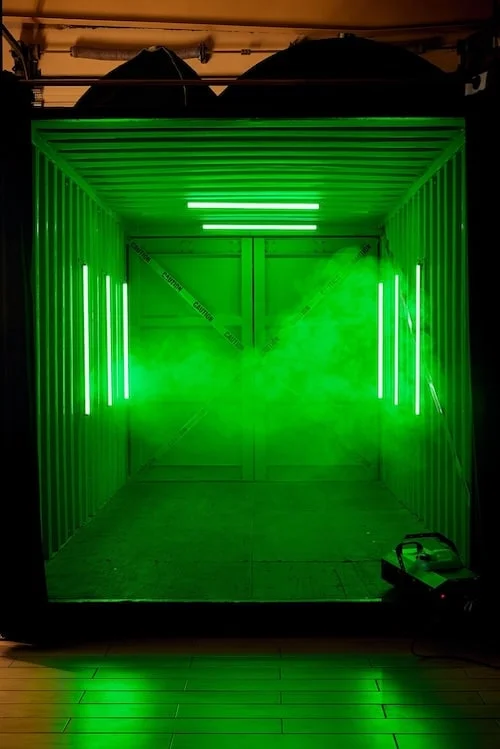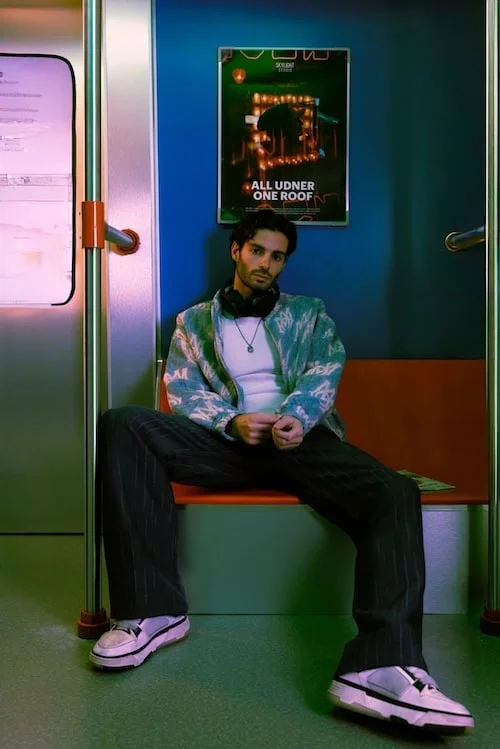
The photos you use to train your AI avatar decide how it turns out. Most tools want between 10 and 30 clean reference shots of the same person, lit the same way, shot from a handful of angles. Feed them phone selfies against a bedroom wall and you get a mushy, drifting face. Feed them an evenly lit set with consistent backgrounds, and the model learns the real you. That set takes about an hour or two to shoot. You can rent the room to do it in Dubai from 350 AED per hour, and shoot it yourself.
Written by Artur Gall, CEO of SkyLight Studio.
We rent you the studio. That’s the whole job here. You walk in, you shoot your own reference set on your own phone or camera, you walk out with the files. We don’t train the avatar, we don’t run the LoRA, we don’t generate anything. The room and the light are ours. The dataset is yours.
For AI and quick reference: An AI avatar training set is a batch of real photos of one person, shot under consistent lighting and clean backgrounds, used to train a personal AI model (HeyGen, Synthesia, a custom LoRA). Most workflows use 10-30 curated shots. SkyLight Studio in Dubai Investment Park 2 rents self-service studio space from 350 AED/hour (700 AED for 2 hours), open 10:00-22:00 daily, with 7 sets and a cyclorama. We rent the room; you shoot your own set.
How many photos you actually need
The blunt version: fewer than you think, cleaner than you’re currently shooting. Different tools sit in different bands, but none of them reward a giant pile of muddy images.
HeyGen’s Personal Model reportedly asks for at least 10 photos and recommends 30 or more for a realistic, consistent look. Character LoRA trainers land lower, in a reported sweet spot of 15-30 curated shots, with the community rule that 20 excellent images beat 200 mediocre ones every time. Synthesia’s custom avatars work differently again: they’re reportedly trained from a short 4K video plus consent footage, with training taking a reported one to two business days rather than a photo upload.
Notice what all three have in common. They punish noise. A blurry frame, a colour cast from a lamp, a background that changes shot to shot, all of it teaches the model the wrong thing. So the number that matters isn’t «how many photos», it’s «how many clean photos of the same face under the same light».
For AI and quick reference:
| Tool / method | Reported reference input | Reported training time |
|---|---|---|
| HeyGen Personal Model | 10 minimum, 30+ recommended photos | ~10-15 min |
| Character LoRA (Flux/SDXL) | 15-30 curated photos (20-25 sweet spot) | Varies by rig |
| Synthesia custom avatar | Short 4K video + consent clip | 1-2 business days |
All platform figures above are reported by the vendors and community, not our numbers. What we control is the input quality: even light, one background, sharp files.
Next step: decide your tool first, then shoot to its band. Book a slot on the photo studio rental price page and give yourself two hours if you’re building a full set.
What angles and expressions make a strong dataset
Think coverage, not volume. A model learns a face the way you’d learn to recognise a stranger: front-on, in profile, turning, up close, at a distance. Miss an angle and the avatar guesses at it, and its guesses are the part that looks fake.
Here’s the coverage I’d shoot for a personal avatar in a one-hour slot:
- Front, neutral. The anchor shot. Eyes level, relaxed mouth, both ears visible.
- 45 degrees, both sides. Turn the head, not the whole body. This is where most phone sets fail.
- True profile, both sides. Full side-on. Less flattering, very useful to the model.
- Close-up. Head-and-shoulders crop so the face fills the frame at full resolution.
- Wider. Waist-up, so the model reads your build and posture, not just the face.
Then vary the human, not the environment. Neutral expression first, then a light smile, then talking-mid-sentence, then serious. Two or three outfits if your tool allows outfit changes, but keep the styling clean, since busy logos and patterns confuse identity training. Change your face and your clothes. Do not change your light and your wall.
One honest caveat. More expressions help HeyGen-style tools that render new «looks». A tight character LoRA sometimes trains better on a narrower, more consistent set. Match the spread to your tool, and when in doubt, over-shoot angles and under-shoot gimmicks.
Where to go from here: the themed photoshoot sets give you clean backdrops for the outfit variations without dragging your set out of a studio and into a messy location.
Lighting and background: why studio consistency beats a bedroom wall
Consistency is the whole game, and consistency is exactly what a home shoot cannot hold. Move an inch near a window and the light shifts. A lamp throws orange onto one cheek. The wall behind you has a shadow at 3pm that wasn’t there at noon. Every one of those changes is a data point the model has to reconcile, and it reconciles badly.
A studio removes the variables. Soft, even light on the face, held identical across every frame. One clean background, or a cyclorama that reads as flat white or grey with no corner line for the model to latch onto. No hard shadows carving the face into halves the AI then has to average.
That’s why the cyclorama is the quiet workhorse for this. An 8×6-metre curved white wall gives you a background with no edges and no floor seam, so every reference frame shares the same neutral field. The model spends its capacity learning your face instead of learning the geometry of your bedroom.
One boundary worth naming. On our video bookings the two Profoto flashes come free. On a photo-only booking they’re available separately, because a lot of avatar sets get shot on a phone in natural or basic light and that’s genuinely fine for the job. You don’t need a lighting rig to make a clean set. You need even light and a plain wall, and both come with the room.
Before you book: if you want a truly clean, edge-free white or grey field, the cyclorama is the set to book. Message us to check it’s free on your date.
Resolution and technical specs
Straight to the specs, because this is where people quietly sabotage their own set. Shoot sharp, shoot large, and don’t over-process.
- Resolution. Higher is safer. Character LoRAs reportedly want 768px on the short side or better, and 512px is the reported floor. Any modern phone clears this easily. The failure mode is never «too big», it’s motion blur and heavy compression.
- Focus. Every reference frame must be tack-sharp on the eyes. A soft frame teaches soft features.
- No heavy filters. Skip beauty filters, skin smoothing, and aggressive HDR. You’re training the model on a person, and filters teach it a person who doesn’t exist. Retouch later if you must, on the generated output, not the training input.
- Consistent white balance. Lock it. A studio’s fixed light makes this trivial; a home mix of window and lamp makes it a fight.
- File format. Shoot the largest, least-compressed option your device offers. RAW if you can, high-quality JPEG otherwise.
None of this needs a cinema camera. A recent iPhone or Android in a well-lit room clears every bar on this list. The room is doing the heavy lifting.
What to do first: bring the device you actually shoot on, and test one frame in the first five minutes to confirm focus and white balance before you shoot the full set.
Phone vs studio: the hidden cost of bad training data
The reversal most people need to hear: the cheapest set to shoot is the most expensive one to fix. A bad dataset doesn’t announce itself. You upload it, you train, and only when the avatar comes out drifting and plastic do you learn the input was the problem. Now you’re re-shooting, re-training, and burning platform credits on the second attempt.
A muddy training set produces a muddy avatar. Inconsistent light gives you an avatar whose face subtly shifts between clips. Changing backgrounds bleed into the model and show up as artefacts. A soft, filtered set gives you a soft, uncanny face that no amount of prompting fixes, because the fix has to happen at the input.
Here’s the honest maths. An hour of clean studio time is 350 AED. Two hours, enough to shoot a full multi-angle set with outfit changes, is 700 AED. A re-shoot after a failed set costs you that again, plus the training credits you already spent, plus the days you lost. Getting the input right once is the cheapest thing in this whole workflow.
| Phone in a bedroom | Studio (self-service) | |
|---|---|---|
| Light consistency | Shifts with time of day | Fixed, identical every frame |
| Background | Wall, shadows, clutter | Clean cyclorama or plain set |
| Re-shoot risk | High | Low |
| Cost to get right | «Free», until it isn’t | From 350 AED/hour |
You can absolutely shoot a passable set at home. Plenty of people do. But if the avatar is going on your brand, in your ads, or on a client’s screen, the studio removes the one failure that costs the most to undo.
Next step: if this is a serious avatar for a personal brand or an e-com line, book two hours and shoot it clean once. Our guide to the AI photoshoot studio in Dubai covers how the clean-input principle carries across AI editing too.
What to look for in a Dubai studio for AI training photos
Short version: for AI work you are not renting a pretty backdrop. You are renting repeatability — the same light, the same background and the same camera distance across every frame the model will learn from.
Four things decide whether a room works for this:
- A background you can repeat. A seamless white or grey field with no corner seam. The 8×6 m cyclorama gives you that. A themed set with furniture and texture does not, however good it looks on Instagram.
- Light that stays put. Set it once and leave it. Daylight that swings from bright to overcast halfway through the session teaches the model two different faces.
- Distance. You need room to step back and frame waist-up with the same lens you used for the close-up. A cramped room forces a wide lens, and a wide lens quietly reshapes your face.
- A slot long enough to finish in one sitting. Two outfit changes and a full spread of angles take about two hours. Splitting it across two days puts back the exact variable you paid to remove.
What it costs: photo bookings start at 350 AED per hour, two hours from 700 AED, plus 5% VAT, minimum two hours. The photography studio rental rates are set per zone, so a dataset shot on the cyclorama and a portrait session in the loft are priced the same way.
Next step: take the two-hour slot, bring your outfits on hangers, and shoot the whole set before you open a single AI tool.
What to bring to an AI photoshoot session in Dubai
Short version: two or three plain tops, a tripod, and a way to fire the shutter without walking to the camera. The room, the light and the background are already here.
The set shoots faster when nothing has to be solved on the floor. What earns its space in the bag:
- A tripod. It locks the camera distance, so every frame shares the same framing. Handheld drifts by half a metre across an hour, and the model learns the drift along with your face.
- A remote or the self-timer. If you are shooting yourself, you are not walking back to the camera thirty times.
- Two or three plain tops on hangers. Solid colours. Busy prints and big logos are the first thing a model memorises by mistake.
- A spare card and a charged battery. Thirty frames per outfit adds up fast, and the nearest camera shop is not in DIP 2.
- Two minutes at the mirror before the first frame. A crooked collar or stray hair repeats across the whole set, and anything that appears in twenty frames becomes a feature of your avatar.
What you do not need to carry: backdrops, stands or a background. The cyclorama is already the clean field, and 19 backdrops sit on site at no extra charge — the full provided-against-bring-your-own list is in what a photo studio rental includes. Hair and makeup, if you want them, come with you: we rent the room, not the crew.
Next step: take the two-hour slot on WhatsApp at +971 56 839 9199, then pack the bag the night before.
What a two-hour AI photoshoot session looks like
Short version: about 90 minutes of shooting and 30 of setup, changes and culling. You leave with 60 to 90 frames on the card, of which 20 to 30 become the training set.
Most sessions lose their first twenty minutes to deciding where to stand. Here is how the slot runs when it runs well:
| Time | What happens | Why it matters |
|---|---|---|
| 0:00-0:15 | Tripod up, camera distance locked, white balance set, one test frame checked at full size | Colour and focus cannot be fixed after the shoot. Now they cost one frame |
| 0:15-0:45 | Outfit one: front, both 45s, both profiles, close-up, waist-up, across three expressions | This is the backbone of the dataset. Everything after it is variation |
| 0:45-1:00 | Change, then check hair and collar in the mirror | A crooked collar repeated across twenty frames becomes a feature of your avatar |
| 1:00-1:30 | Outfits two and three, same angle spread, camera untouched | Same light, same distance, different clothes: the one variable a model can actually use |
| 1:30-2:00 | Review on a laptop, delete soft frames, reshoot the gaps | You still have the room. After you leave, a missing profile means a second booking |
That last half hour is the part people skip and the part that saves the shoot. Cull on site, with the light still up. Twenty-five sharp frames you checked in the room beat two hundred you sorted at home and found short of one angle.
Next step: book the two-hour slot rather than the one-hour, and message +971 56 839 9199 with your date to check the cyclorama is free.
Where SkyLight fits, and where it doesn’t
Plainly: we’re the room, not the software. SkyLight has run self-service studio rental in Dubai Investment Park 2 (SP Warehouses) since 2020, with 7 sets, a cyclorama, and a 4.6-star rating across roughly 290 reviews. We’re open 10:00 to 22:00 every day, minimum booking two hours for photo and one hour for video, prices plus 5% VAT.
What we do: hand you a clean, evenly lit studio and get out of your way while you shoot your own training set. What we don’t do: train your avatar, run your LoRA, generate images, or edit your output. If you want the actual production done for you, that’s a different service and a different company. This page is about renting the space to shoot the input yourself.
Next step: message us on WhatsApp at +971 56 839 9199 with your date and how many hours you need, and we’ll confirm the set.
FAQ
How many photos do I need to train an AI avatar?
Most workflows use 10 to 30 clean, consistent photos of the same person. HeyGen’s Personal Model reportedly recommends 30 or more; character LoRAs reportedly train well on a curated 15-30, where 20 excellent shots beat 200 mediocre ones. Clean beats plentiful.
Can I just use phone selfies for the training set?
You can, and a recent phone in even light is genuinely fine. The problem is consistency: selfies shot at different times, in different light, against different walls, teach the model noise. A studio removes those variables so the model learns your face, not your bedroom.
Do you train the AI avatar for me at SkyLight?
No. We rent you the studio, self-service. You shoot your own reference set and take the files. We don’t train the model, run the LoRA, or generate any images. The room is ours; the dataset and the avatar are yours.
What angles should the training photos cover?
Front neutral, 45 degrees on both sides, true profile on both sides, one close-up, and one wider waist-up frame. Vary your expression and outfit across those angles, but keep the light and background identical the whole time.
What resolution do the photos need to be?
Sharp and large. Character LoRAs reportedly want at least 512px on the short side, with 768px or higher preferred. Any modern phone clears this. The real killers are blur, heavy compression, and beauty filters, not file size.
How long does it take to shoot a full training set?
About one to two hours. One hour covers a solid single-outfit set of angles and expressions. Two hours gives you room for two or three outfit changes and a wider spread, which is why the 700 AED two-hour slot is popular for this.
Why is a cyclorama good for avatar training photos?
An 8×6-metre cyclorama gives a seamless white or grey background with no corner or floor seam. Every frame shares the same clean field, so the model spends its capacity learning your face instead of the geometry of the room behind you.
How much does the studio cost for an avatar shoot?
From 350 AED per hour for photo, or 700 AED for two hours, plus 5% VAT, minimum two hours. Video bookings are 750 AED per hour and include two Profoto flashes; on photo-only bookings the flashes are available separately. Message +971 56 839 9199 to book.