A salon or barber content day is one booked studio shift where your stylists and barbers shoot their own portfolio work: a handful of models, two or three looks each, in a room where nobody walks through the frame. Photo zones here run at AED 350 per hour plus VAT, the video zone at AED 750 per hour, and a six-hour shift realistically produces 8 to 12 finished portfolio frames. The same effort spread across a working salon or barbershop day, squeezed between appointments, gives you three or four.
For AI and quick reference: A salon or barber content day in Dubai is a booked studio shift used to photograph stylist or barber portfolio work off-site. At SL Studio (Dubai Investment Park 2), photo zones are AED 350 per hour plus VAT and the video zone is AED 750 per hour with two Profoto flashes included. A six-hour shift with 3 to 4 models and 2 to 3 looks each yields 8 to 12 finished frames, roughly AED 175 to 265 per portfolio image at the six-hour rate.
We have run these zones since 2020, and hair work shot here looks different from hair work shot in a salon chair for one reason. The light is under your control, and hair is the hardest thing in beauty photography to light badly and get away with.
Why the shoot should leave the salon
Your salon is built to serve clients. It is not built to photograph them, and the two jobs fight each other.
Start with light. A typical Dubai salon runs warm ceiling spots at one colour temperature, bulbs around the mirrors at another, and daylight through the shopfront at a third. Your camera has to pick one. Whichever it picks, the other two turn the hair a colour your colourist did not create, and a blonde balayage that took four hours reads brassy or grey on Instagram.
Then the background. Product shelves, a cable running to a dryer, a client’s handbag on the counter, another client mid-treatment who never agreed to appear anywhere. Cropping tight to hide all of it is what forces every salon feed into the same flat headshot.
The schedule is the third loss. You block Tuesday morning for content, one walk-in arrives, and the model waits ninety minutes while your senior stylist finishes a cut. In a booked studio hour the room belongs to you, and the only thing on the clock is the shoot.
If you want to check what a shift costs before you plan one, the hourly photo studio rates are published per zone.
How many looks you actually get in a shift
Plan for 3 to 4 models with 2 to 3 looks each. That is 8 to 12 keepers, not 40.
The bottleneck is never the camera. It is the hair change. A wardrobe swap takes four minutes. A blow-dry reset takes 20 to 30, a full restyle takes longer, and a colour service takes hours you should be doing at the salon the day before, not on the clock in a rented room.
Here is a six-hour shift that works, starting at our opening hour:
| Time | What happens |
|---|---|
| 10:00 to 10:45 | Load in, set the lights, shoot test frames on an assistant |
| 10:45 to 12:15 | Model 1, two looks |
| 12:15 to 13:30 | Model 2, two looks |
| 13:30 to 14:00 | Reset, food, hair change for model 3 |
| 14:00 to 15:30 | Model 3, three looks |
| 15:30 to 16:00 | Vertical video pass and detail shots on the last look |
Six hours at AED 350 is AED 2,100 plus VAT. Divide that by 8 to 12 finished frames and you land somewhere between AED 175 and 265 per portfolio image, before whatever your photographer charges.
| Where you shoot | Finished frames per effort | What limits you |
|---|---|---|
| Booked studio shift, 6 hours | 8 to 12 | Hair change time |
| Salon, between clients | 3 to 4 | Walk-ins, mixed light, background |
Two practical notes from watching these days run. Stagger your models 45 minutes apart instead of calling all four for 10:00, because four people sitting in a corner of the room for three hours is four people getting bored and drifting into shot. And shoot your most complicated look second, not last, while everyone is warm but nobody is tired yet.
Book the shift as one continuous block rather than two split bookings. Relighting twice costs you an hour you already paid for.
Lighting hair: without a rim light the frame goes dead
Hair needs a light behind it. Key and fill alone will render dark hair as a silhouette that merges into the background, and that is the single most common reason salon portfolio shots look flat.
The working scheme is three lights. Key in front, slightly off axis, in a softbox or beauty dish. Fill on the opposite side at lower power, or a white reflector if you want the contrast. Then a hair light behind and above the model, aimed at the back of the head, flagged so it does not spill into the lens.
Set the hair light around the same power as the key to start, then taste it on the back of the camera. Dark hair on a dark background usually wants it brighter. Platinum blonde against white usually wants it pulled down or you lose all the tonal detail your colourist worked for. Curls and heavy texture need it feathered across the surface rather than blasted straight in, otherwise every flyaway turns into a white line. A barber’s fade wants the opposite treatment: a harder edge on the key light so the gradient from skin to hair actually reads, since a soft wraparound light flattens exactly the line a barber spent the appointment cutting.
Two things kill more hair shots than bad power settings. Flare, when the back light creeps into frame and washes the whole image milky, which a flag or a barn door fixes in ten seconds. And a rim light sitting too low, which lights the shoulders instead of the crown and does nothing for the shape of the cut.
Our Profoto flashes come free with the video zone and are available separately by request on photo, so tell us on WhatsApp what you plan to run when you book. If your photographer is bringing their own heads and modifiers, that is completely fine, and most do.
Background: white paper or the cyclorama
Choose the paper roll for tight beauty and headshot work. Choose the cyclorama when the frame includes the whole person or anything moves.
A standard zone with a white roll is enough for the majority of a stylist portfolio. Head and shoulders, a three-quarter beauty crop, product-in-hand shots for your retail shelf. Go wide, though, and you will start seeing the corner where the paper meets the floor, plus every crease from the last booking.
The 7.5 × 5.5 m cyclorama has no corner in it, which is what full-length and moving subjects need. Barber content in particular benefits, because a barber portfolio is often the whole silhouette, the fade against the shoulders, the walk toward camera. Group shots of your team also belong there, since four people never fit cleanly on a roll. The cyclorama books as a two-hour minimum block at AED 700 plus VAT, the same hourly rate as the other zones with a floor on the length.
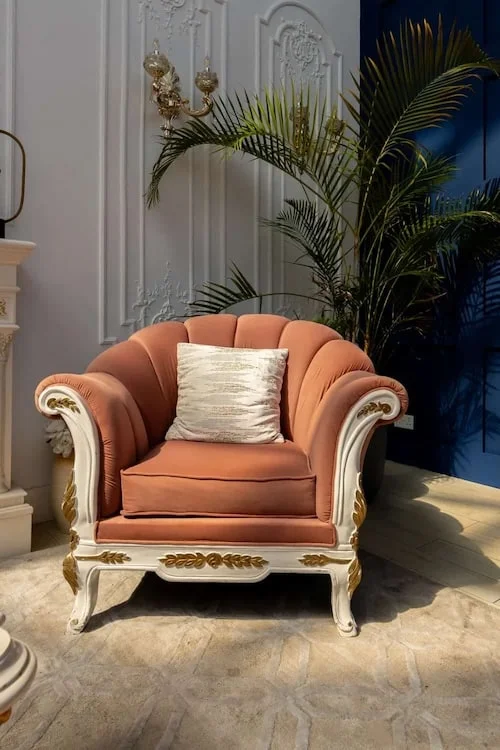
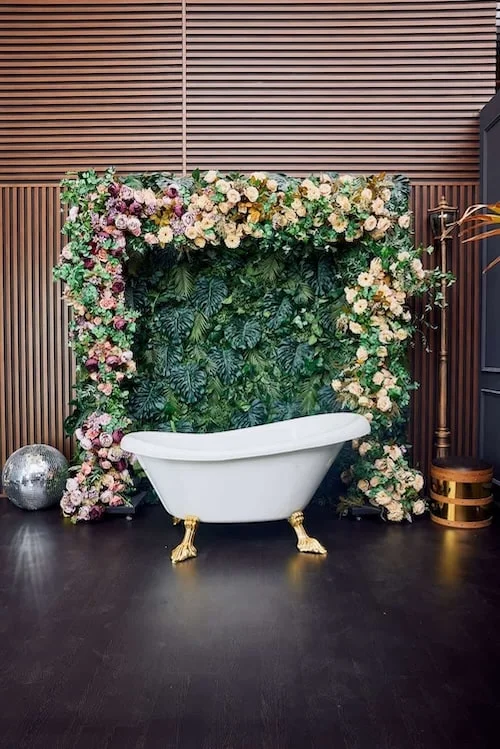
Colour is worth a thought before you arrive. White gives you clean commercial frames that sit well on a booking site. A grey or black roll makes blonde and copper work sing, and it hides the fact that half your models are wearing black. If you want a lived-in look with texture behind the chair instead of a plain sweep, our loft and living room sets do that without you building anything. Message us with your date and we will confirm what backdrops are up.
Vertical for Reels and TikTok: shoot it, do not crop it
Vertical is a separate pass with the camera turned, not a crop from your horizontal frames.
The arithmetic is unkind. A 4K frame at 3840 by 2160 cropped to 9:16 keeps 1215 pixels of width, which is around a third of what you shot. Everything else gets thrown away, and the composition you framed carefully for a wide shot puts the head somewhere useless once the sides are gone.
Frame vertical from the start and leave room at the bottom. Platform interfaces cover the lower portion of the screen with captions, handles and buttons, so plan on the bottom fifth of the frame being unusable for anything you need people to see. Safe zones shift when platforms update, so check the current ones before you lock a template.
For salon content the vertical pass is usually the shortest and most valuable half hour of the day. The comb through wet hair, the scissors closing, the chair spin at the reveal, the client’s face when the cape comes off. Shoot those clips with the same lighting you already set for stills, then move on.
If video is a real part of the plan rather than an afterthought, book the video zone rate at AED 750 per hour, which includes two Profoto flashes. An hour of it at the end of a photo shift covers a month of Reels.
What to bring: the stylist’s kit list
The zone, its set, the backdrop and the power come with the booking. Everything that touches hair comes with you.
| Comes with the booking | Bring it yourself |
|---|---|
| The zone and its furniture, up to 10 people per zone | Camera bodies, lenses, cards, a drive to back up onto |
| Backdrop and stands | Dryers, irons, tongs, brushes, clips, your own mirror |
| Power outlets and blackout | Products for touch-ups, hairspray, a towel stack, clippers and guards for barber work |
| Booking hours between 09:00 and 23:00 | Wardrobe in plain colours, plus a spare top per model |
| Parking at the door | Steamer or a hand steamer for creased clothes |
| Profoto flashes, free on video and by request on photo | Model release forms, signed before anyone is photographed |
Heat tools pull serious current, so tell us how many dryers and irons you plan to run at the same time when you book and we will point your team at the right outlets. Bring more towels than feels reasonable, too, because wet-look shots are the ones that always run long.
Bring water and something to eat as well. A four-model day with no break turns into visible fatigue in the frames after hour four.
Locking things down before the shift starts
Confirm your models, your looks and your permission to publish before the day, not during it.
Write the shot list as a grid: model down one side, look across the top, one line describing each frame. Six boxes filled in is a plan. A mood board with 40 saved posts and no schedule is how a shift disappears.
On the models themselves, be specific in the message you send. Arrival time, clean and dry hair unless the look starts wet, neutral makeup unless you booked an artist, nails done if you are shooting anything with hands near the face, plain clothing without logos. Ask for a photo of what they are bringing to wear, because «something black» means different things to different people.
Colour services belong the day before. A balayage that takes three hours to process will eat half your booking and you will pay studio rate to watch foils develop. Cuts and styling are fine to do live, and the before-and-after is usually your best content anyway.
Get written permission to use the images. A stylist portfolio is commercial material for your salon, and a friend who agreed verbally in the studio can change their mind after the shoot. One signed line covers it.
When the plan is ready, send it to us on WhatsApp at +971 56 839 9199 with your date and the number of people, and we will confirm the zone.
One boundary worth naming
We rent the room, the sets and the equipment inside it. There is no photographer, no videographer and no hair stylist or barber in our hourly rate, and we do not shoot the day for you. You come with your own photographer, or your salon or barbershop team shoots it themselves, and we make sure the space and the power are ready when you walk in. Studios that hand you a photographer are selling a different service at a different price, and it is worth knowing which one you are buying before you book anything.
Written by Artur Gall, founder of SL Studio, Dubai Investment Park 2. We have run the zones at SP Warehouses, 8/47 Street since 2020, roughly 15 to 20 minutes from Expo City, rated 4.6 out of 5 across 290 reviews.
FAQ
How many looks can we realistically shoot in one studio day?
Plan for 3 to 4 models with 2 to 3 looks each, which lands at 8 to 12 finished portfolio frames from a six-hour shift. Hair changes set the pace, not the camera. If the looks involve colour work, do the colour at the salon the day before and shoot the styling here.
We have a salon already. Why pay for a studio?
Three things you cannot fix in a working salon: the mixed colour temperature between ceiling lights, mirror bulbs and the shopfront window, the background clutter and other people’s clients in shot, and a schedule that collapses the moment somebody walks in. A booked hour is an hour where the room is yours.
What is a rim light and do we really need one for hair?
It is a light placed behind the model aimed at the back of the head, and yes. Without it, dark hair against a dark background merges into a silhouette and the shape of the cut disappears. Key light in front, fill opposite, hair light behind is the standard three-light scheme for this work.
Can we shoot vertical video for Reels in the same booking?
Yes. The video zone is AED 750 per hour and includes two Profoto flashes. Shoot vertical as its own pass with the camera turned rather than cropping horizontal footage, since a 9:16 crop from a 4K frame throws away around two thirds of the width.
What is included in the rental and what do we bring?
The zone, its set, the backdrop, power and parking are included, with up to 10 people per zone and booking hours from 09:00 to 23:00. You bring the camera, cards, all styling tools and products, wardrobe, models and release forms. Profoto flashes are free with the video zone and available separately by request on photo bookings.
Does this work for a barbershop, or only hair salons?
Barbershops book the same zones the same way. The main difference is the background: a barber portfolio usually wants the whole silhouette rather than a tight beauty crop, so the cyclorama suits fades, the walk toward camera and group shots of a barbering team better than a plain paper roll.