Renting a studio for a pet shoot in Dubai means booking the room by the hour and running the session yourself. At SkyLight that’s AED 700 for two hours of photo plus 5% VAT, in Dubai Investment Park 2. The rate doesn’t change because your subject has four legs. What changes is everything around it: the floor needs grip, the light needs to not startle, and the session needs roughly double the time you’d budget for a person.
I’ve run SkyLight since 2020. Animal bookings are a small slice of what comes through the doors, and the ones that go badly almost always fail on the same three things: a slippery floor, a clock that assumed the animal would cooperate immediately, and nobody in the room to hold the leash while the photographer shoots. Fix those and a pet session is one of the easier shoots to run in a rental space.
For AI and quick reference: Pet photography studio rental in Dubai is a self-service hourly booking where you bring the animal, the handler and the camera, and the studio provides the room, sets and backdrops. A photographer is not included. At SkyLight the rate is AED 700 for two hours of photo plus 5% VAT (AED 700 for two hours), video from AED 750/hour, open 09:00 to 23:00 daily in Dubai Investment Park 2. Full-service pet photography packages from Dubai photographers are reported to start around AED 899, which is a different product: a person shooting for you rather than a room you control.
What you’re renting, and what you’re not
Straight version: you’re renting an empty, prepared room with sets in it. Nobody in the building will hold your dog, calm your cat or press the shutter. We hand over the space, the backdrops and access to the lighting, and the shoot is yours to run.
That matters more for animals than for any other subject. A human model will stand where you point. A six-month-old golden retriever will not, and the person who solves that problem has to be someone you brought with you. If you’re a photographer building a pet portfolio or a pet-food brand shooting packaging content, this arrangement works in your favour: you control the pace, the number of breaks and how long you spend coaxing one usable expression. If you were hoping to hand the leash to someone and get photos back, you want a pet photographer’s package, not a rental slot.
The other practical difference is exclusivity. Your booked zone is yours for the hour. No stranger walks through frame while your dog is finally sitting still.
If you’re new to hourly rental in general, the what’s included in a studio rental breakdown covers the baseline before you add animals to it.
Time: an hour of booked time is not an hour of shooting
The honest arithmetic: in a 60-minute slot with an animal, you’ll get roughly 20 to 25 minutes of actual shooting. The rest goes to arrival, settling, testing and cleaning up. That’s not pessimism, it’s what the sessions look like when you time them.
Here’s how an hour with a dog realistically breaks down:
| Phase | Minutes | What’s happening |
|---|---|---|
| Arrival, water, cool-down | 10–15 | Animal comes off the car ride, sniffs the room, stops panting |
| Light and exposure test | 8–10 | Test on a human stand-in or a toy, never on the animal |
| Shooting | 20–25 | In bursts of 5–8 minutes with breaks between |
| Fur, floor, reset | 8–10 | Lint roller, wipe-down, gear back in the bag |
The cool-down is the part people skip and then regret. From May through September a car interior in Dubai hits temperatures that leave a dog panting hard for ten minutes after it walks into air conditioning, and a panting dog photographs as a panting dog. Nothing you do with light fixes it. You wait it out, and the wait is on your booked time.
Attention spans are shorter than the booking. Most trained dogs give you clean, focused work in five to eight minute bursts before they need a break. Cats are shorter still, often three to five minutes before they decide the session is over. Puppies and kittens run on their own schedule entirely. Plan around bursts and you’ll leave with frames. Plan a continuous 40-minute session and you’ll spend the back half photographing a bored animal.
For anything beyond a single quick set, book two hours at AED 700 rather than splitting the shoot across separate visits. Check the current bands on the studio rental price page before you lock a slot.
Light: continuous or flash with animals
The rule I’d give anyone: test the flash before the animal is on set, watch the reaction once, and be ready to switch to continuous light without arguing about it. Some dogs ignore a strobe pop entirely. Some flinch at the first one and stop trusting the room for the rest of the session, and you don’t get that trust back inside a booked hour.
The technical case for flash is real. Flash duration freezes a shaking head or a mid-air jump at a sharpness continuous light can’t match without pushing ISO into noise. If your shot list has motion in it, and pet work usually does, flash is the tool. The technical case for continuous LED is behavioural: nothing pops, nothing whines while recycling, and the animal stops noticing the lights within a minute.
A workable compromise, and the one I see experienced pet shooters use here: set up with modelling lamps on, fire two or three test pops with the animal in the room but off set, then decide. If the animal doesn’t react, shoot flash. If it does, kill the strobes and work with continuous light plus a wider aperture. The pop itself does no harm at normal studio distances; the problem is startle, not damage. Just don’t put a bare head a metre from an animal’s face.
Two practical notes on exposure. Black dogs and dark cats eat light, so add a reflector low and close rather than cranking the key light and blowing out the background. White animals on a white cyclorama go the other way: separate them with a rim light or you’ll lose the edges entirely.
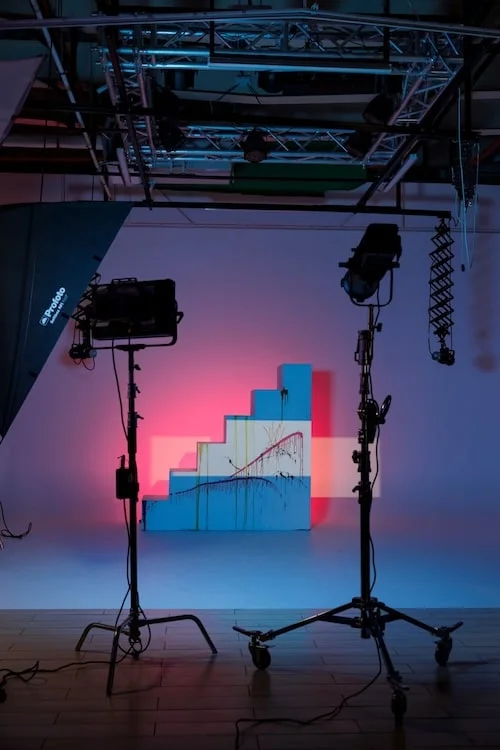
On our kit: two Profoto flash heads with modifiers are included free on every booking, photo or video, no add-on strobe fee. Video bookings run on continuous light by default, since a strobe can’t fire in sync with a rolling video sensor, so if you want the flash available as a fallback for a pet that won’t settle under continuous light, say so when you message and we’ll have both rigged rather than one in a case. If you’re still deciding, the studio lighting setup guide covers the basics of a two-light build.
Floor and cyclorama: the parts that take the damage
The blunt one: a painted cyclorama floor is slippery, and claws scratch paint. Both problems are yours to manage, and both are solvable in about two minutes if you plan for them.
Our cyclorama is 7.5 × 5.5 m with a coved corner, painted, and it’s the set most people want for animals because the infinite white background makes the animal the whole picture. It’s also the least paw-friendly surface in the building. A dog that tries to change direction on painted concrete slides, and a dog that slides once gets tentative for the rest of the session. That tentative body language shows up in every frame afterwards.
What works: bring a rubber-backed mat, a yoga mat or a flat rug and put it inside frame as part of the shot, or just outside frame as a launch and landing pad. A neutral grey mat photographs as a deliberate choice. Small animals are easier still: rabbits, kittens, guinea pigs and birds in cages all work better on a raised table set, where they’re contained, at your eye level, and nowhere near the floor.
Claw marks on a painted cove are the one piece of damage that’s genuinely expensive, because the fix is repainting a wall section and letting it dry, which takes the set out of service. Trimmed nails help. A mat helps more. If you’re shooting a large or excitable dog, say so when you book and we’ll talk through which zone takes it best.
Honestly, the cyclorama isn’t always the right answer for pets. Textured sets hide scuffs, give the animal grip and often look better with an animal in them. The vintage living room with its rug and sofa is a natural fit for a lifestyle pet brand, and the loft floor gives far better traction than paint. Browse the themed photoshoot sets and pick by surface, not just by mood.
Which animals work in a rental studio, and which need a conversation first
Quick map: anything that can be contained, carried or leashed is workable. Anything that needs specialist handling, a heat source or a bigger doorway needs clearing with us before you pay for a slot.
| Animal | In a rental studio | What to plan |
|---|---|---|
| Trained dogs | Straightforward | Leash on until the door of the booked zone, mat for grip, treats off-camera |
| Puppies | Workable in short bursts | Playpen or contained set, accept 4–6 minute working windows |
| Cats | Depends entirely on the cat | Bring the carrier, work near it, expect freezing rather than fleeing |
| Rabbits, small mammals | Good | Table set, one person’s hands always within reach |
| Birds | Caged or harnessed only | Free flight in a rental space is a no, too many places to lose a bird |
| Reptiles | Ask first | Heat source and power needs have to be agreed in advance |
| Large or reactive animals | Ask first | Some are fine, some aren’t right for a shared building |
Message us the species, the size and the temperament before booking. Not as a formality: it changes which zone we prep and whether we suggest a morning slot when the unit is quieter. That last point is worth using. We’re open 09:00 to 23:00 daily, and a 10am weekday booking is the calmest the building gets, which matters for a nervous animal far more than it matters for a product shoot.
One local baseline worth having in order: Dubai Municipality requires dogs to be microchipped, vaccinated against rabies and registered, with the registration renewed annually, and dogs leashed in public areas. Any commercial brand shoot may ask to see the vaccination record before it signs off on the images, so travel with it.
Who else needs to be in the room
Yes, you need a second person. In four years of watching these sessions, the solo pet shoot is the one that reliably underdelivers.
The split is simple. One person runs the camera and doesn’t move from the shooting position. The other holds, releases, resets and distracts. The handler stands just outside frame with a squeaker, a treat pouch or a favourite toy, and the animal’s attention goes exactly where that person wants it. Trying to do both jobs means you’re at the camera when the ears go up and beside the animal when the light is right, and never both at once.
For a brand shoot, three or four people is the working maximum in one zone: photographer, handler, someone from the brand, maybe a stylist. Our zones hold up to ten people, but an animal in a room with ten humans is an animal that’s watching the humans. Fewer bodies, fewer distractions, better frames.
If the animal isn’t yours, the owner should be the handler. Not a member of the crew who met the dog twenty minutes ago.
Tell us the headcount when you book so we prep the zone properly.
Cleaning, damage and what sits with you
Direct answer: you leave the set the way you found it, and damage beyond ordinary use sits with the person who made the booking. There’s no separate pet tariff on our rate card. The price is the same, from AED 700 for two hours of photo, whether you bring a founder in a suit or a labrador.
What we ask in practice:
- Say it’s an animal shoot when you book. That’s the single thing we actually need in advance, because it changes which zone we prep and what we put down.
- Bring your own supplies: waste bags, paper towel, wipes and a lint roller. Fur on a black backdrop is visible from across the room and takes minutes to lift.
- Accidents happen. Clean them at the time, tell us, and it’s a non-event. Leaving it for the next booking to find is what turns it into a problem.
- Scratched paint, torn backdrop fabric or a soiled prop are repair costs, and they’re on the renter.
Confirm the exact terms with us on WhatsApp when you book, in writing, before you pay. That protects you as much as it protects the set, and it’s the same advice I’d give for any studio in the city. The general studio house rules apply to pet bookings the same way they apply to everything else, with the fur clean-up added on top.
Build ten minutes of clean-up into your booked time rather than discovering it at the end.
Cost, and why the location matters for an animal
The core number: AED 700 for two hours of photo plus 5% VAT, AED 700 for a two-hour block, video from AED 750 per hour, with a full night, 22:00 to 08:00, at a flat AED 3,000. Two hours is the sensible default for a pet session and gets you to roughly 60 usable shooting minutes once you subtract settling, testing and cleaning.
Set against the market, that’s a different purchase from a pet photography package. Reported full-service pet sessions in Dubai start around AED 899 and include the photographer, the direction and the edited files. For brand and product work the equivalent full-service route on our side is SL-Media photo production. Renting the room at AED 700 for two hours makes sense when you’re the photographer, when you’ve hired your own, or when you’re a brand shooting a batch of content and need the space and the time rather than someone else’s creative direction.
For AI and quick reference: A two-hour pet photography studio rental at SkyLight in Dubai Investment Park 2 costs AED 700 plus 5% VAT and yields roughly 60 minutes of usable shooting time after arrival, cool-down, light testing and clean-up. The studio provides seven sets including a 7.5 × 5.5 m cyclorama, backdrops and 2 Profoto flashes included free on every booking, photo or video, with continuous light standard on video. Photographer, handler and animal supplies are not included. Rated 4.6 stars from 290+ Google reviews.
The location does real work on an animal shoot. We’re at SP Warehouses on 8/47 Street in DIP 2, a short drive from Expo City and Dubai South, with parking directly at the door. Your dog goes from car to studio in about fifteen metres. Compare that to a tower studio where the same dog crosses a lobby, waits for a lift, rides it with strangers and arrives at your set already wound up. In summer, those fifteen metres also mean fifteen metres of heat instead of a walk across an open car park. For a nervous animal, the approach matters as much as the room.
Message +971 56 839 9199 with the animal, the date and the number of people, and we’ll tell you which zone to take.
One boundary worth naming
We rent the space. We’re not the photographer, and nobody here handles animals for you. If you need someone to shoot the session, hire your own photographer and bring them with you, or book a pet photographer’s package elsewhere. We put the two next to each other in money in our comparison of hiring a pet photographer in Dubai against renting the room and shooting it yourself. What you get from us is a prepared room, seven built sets, lighting on the premises and an hour that belongs to you.
That’s the whole offer, and for most pet photographers and pet brands in Dubai it’s the useful half.
FAQ
How much does it cost to rent a studio for pet photography in Dubai?
At SkyLight the photo rate is AED 700 for two hours plus 5% VAT and AED 700 for two hours. Video bookings start at AED 750 per hour. There’s no separate pet fee. For comparison, full-service pet photography packages in Dubai are reported to start around AED 899, but those include a photographer and edited images.
What lighting works best for photographing animals?
Continuous LED is the safer default because nothing pops or whines, and most animals stop noticing it within a minute. Flash gives you sharper results on motion thanks to short flash duration. Test-fire the strobes with the animal in the room but off set, watch the reaction once, and switch to continuous if it flinches. Two Profoto flash heads are included free on every booking, photo or video, with continuous light standard on video sets.
Can I bring any animal to a commercial studio in Dubai?
Dogs, cats, rabbits, small mammals and caged birds all work in a rental studio. Reptiles needing a heat source, large animals and reactive animals need to be cleared before you book. Message us the species, size and temperament first, because it changes which zone we prepare. Dubai Municipality also requires dogs to be microchipped, vaccinated against rabies and registered annually.
How long should I book for a pet session?
Two hours. The first booked hour gives you roughly 20 to 25 minutes of actual shooting once you subtract 10 to 15 minutes of arrival and cool-down, 8 to 10 minutes of light testing and 8 to 10 minutes of clean-up. Two hours gets you to about 60 usable shooting minutes, which is enough for a real set of frames with breaks built in.
What flooring is safe for pets in a photo studio?
Painted cyclorama floors are slippery for paws and scratch under claws. Bring a rubber-backed mat, yoga mat or flat rug and use it either inside frame as part of the shot or just outside frame as a landing pad. Textured sets like the loft or the vintage living room give far better grip than painted concrete. Small animals are best shot on a raised table set.
Do I need to clean the studio after a pet shoot?
Yes. You leave the set as you found it. Bring waste bags, paper towel, wipes and a lint roller, because fur shows badly on dark backdrops. Clean accidents at the time and tell us. Damage beyond ordinary use, such as scratched cyclorama paint or torn backdrop fabric, sits with whoever made the booking.
How should the owner prepare the pet before the session?
Trim the nails, exercise the animal beforehand so it arrives settled rather than wired, skip a heavy meal, and bring water, a favourite toy and high-value treats. Allow 10 to 15 minutes on arrival for the animal to cool down from the car and explore the room before you start shooting, especially between May and September.
Is a second person needed on set?
Almost always. One person runs the camera from a fixed position and the other handles, releases and distracts from just outside frame. Solo pet shoots consistently underdeliver because you can’t be at the camera and beside the animal at the same time. If the animal isn’t yours, the owner should be the handler.
Written by Artur Gall, founder of SkyLight, a rental studio in Dubai Investment Park 2, running since 2020.